


Contents
Scroll to:
https://doi.org/10.17073/2500-0632-2025-07-1003
Scroll to:
Declining ore grades at the Norilsk deposits are accompanied by increasing variability in the quality of mined ore and deterioration in the quality of saleable products. These trends necessitate a revision of the fundamental approaches to optimizing mining systems for ore-stream quality management. This study aimed to advance the theoretical framework and improve the methodology for substantiating process engineering solutions for integrated ore quality management in underground mining through innovative modernization of mine flowsheets. An integrated research approach was employed, including a review of previous studies; analysis of Russian and international experience in ore-stream management; field sampling of ore in deposits and along ore streams, followed by geological and mineralogical testing and correlation analysis; production-scale investigations of particle-size segregation during mining; analytical studies based on probability theory and mathematical statistics; and modern modeling methods. An updated classification of methods for assuring and controlling ore quality in underground mining is proposed. Blending methods are classified as blending and stabilization methods aimed at achieving and maintaining the required quality of mined ore, whereas segregation and separation methods are intended to divide, separate, or sort the material. Production-scale investigations confirmed that considerable potential exists for more effective control of ore-stream quality. Fundamental principles were formulated for developing process engineering solutions at the underground-mine design stage to manage copper-nickel ore quality and substantially improve the quality of mine products.
Turtygina N.A., Okhrimenko A.V., Glinsky A.V., Ryzhenkov K.A. Mine design and process engineering solutions for copper-nickel ore quality management in underground mining. Mining Science and Technology (Russia). 2026;11(2):130-140. https://doi.org/10.17073/2500-0632-2025-07-1003
One of the principal requirements imposed by consumers on mineral raw materials is the consistent quality of the material extracted from the subsurface. Underground mining of ore deposits amid declining ore grades is generally accompanied by deterioration in the quality of mined ore, requiring mining companies to improve their competitiveness. The Norilsk copper- nickel deposits are no exception in this respect. For the underground mines of the Norilsk Division of PJSC MMC Norilsk Nickel, addressing this challenge primarily requires meeting market demand for higher-quality saleable ore and increased metal output while expanding the mining and processing of ore with progressively deteriorating quality characteristics. Research aimed at advancing the theory and technologies of integrated ore quality management in underground mining is therefore both relevant and timely. The present study is driven by the need to identify process engineering solutions capable of substantially improving the quality of mine products under conditions of steadily declining grades in the remaining ore reserves.
The following objectives were formulated:
At present, the high-grade ore deposits of the Talnakh ore cluster are being mined most intensively. The mineral material extracted from the subsurface comprises three commercial types of copper-nickel ore – high-grade, cuprous, and disseminated ores – as well as diluting material consisting of waste rock and cemented backfill. The run-of-mine material produced by the mines is supplied as feed to the Norilsk and Talnakh concentrators. The chemical composition of the feed material significantly affects concentrate production, the metallurgical process as a whole, and metal recovery.
Statistical processing of a large dataset was used to forecast changes in ore production and the recoverable value of the mined ore. The analysis indicates that over the next 20 years of underground mining at the Norilsk ore deposits, the total value of recoverable components per tonne of copper-nickel ore will decline (Fig. 1).
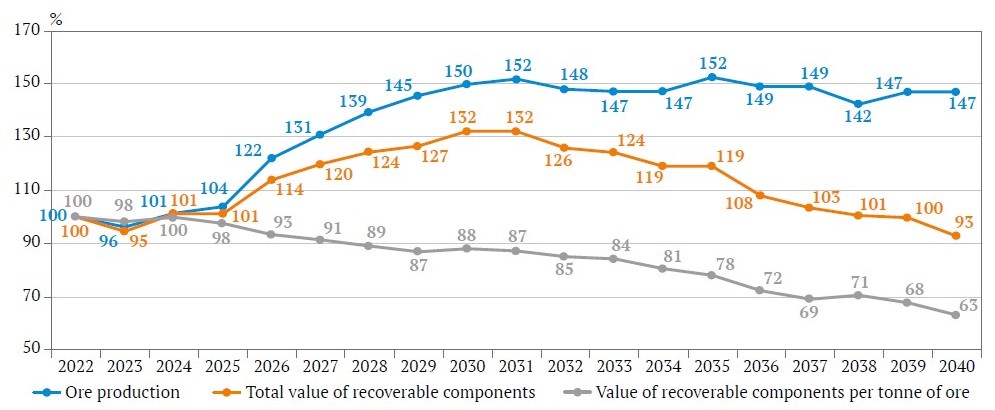
Fig. 1. Forecast changes in ore production and the value of recoverable components during development of the Norilsk ore deposits
Against this background, the planned 30% increase in mine production relative to the current level, together with the gradual introduction of lower-grade disseminated and refractory ores, is expected to reduce the recoverable value of the mined ore by 35% or more. Thus, as the quality of the commercially mineable reserves of the principal ore types declines, a comprehensive basis is required for mine design solutions aimed at optimizing underground grade-stabilization systems. Such solutions should combine innovative modernization of mine flowsheets with additional process engineering measures designed to improve the quality of the mined material. This makes it necessary to revise several fundamental principles of ore quality management in mining operations at the Norilsk deposits [1].
An integrated research methodology was employed, including a synthesis of findings from previous studies; analysis of Russian and international experience in ore-stream management; in-situ sampling of ore within the deposits and along the ore streams, followed by geological and mineralogical characterization and correlation analysis; production-scale investigations of ore segregation during mining; analytical studies based on probability theory and mathematical statistics; and modern modeling methods. The authors’ contribution included establishing correlations between metal grades in the ore and particle-size classes under the operating conditions of the mines, as well as updating and systematizing methods for ore quality management in underground mining. For the first time, analytical studies and field observations were conducted to assess the blending capacity of individual stages of the mine production chain, and computer modeling was performed for the preconcentration of valuable components in the ore. A mine flowsheet was developed for an underground system designed to establish and stabilize ore quality during mining. The content and architecture of a minewide information and control system for real-time ore quality monitoring throughout the entire mining production chain were also substantially redesigned.
Ore quality management during mining is inherently a techno-economic problem and is generally achieved through process control, ore blending, realtime control of mining operations, separation of ore streams into different material-handling routes as the extracted mineral material is delivered from the mine, and other measures [2].
In the authors’ view, the multistage mine planning process is initially intended to establish the target average metal grade in the planned ore output, whereas organizational and operational processes are intended to ensure that this grade is distributed uniformly throughout the ore streams by mechanical mixing. Mined ore can be mixed in load-hau-dump and haulage equipment, mechanical crushers, ore passes, underground bins, stockpiles, and storage facilities. Taken together, these processes provide mined mineral material with the optimum average quality1. Ore quality management should therefore be understood as a set of organizational and production measures 133 implemented within the underground mine system to establish the optimum average quality of the ore during mining and ensure that this quality is distributed uniformly throughout the mined material [3, 4]. Overall, blending and separation operations form the basis of mineral raw material quality management during deposit development [5]. In view of these considerations, the methods used to assure and control ore quality in underground mining were updated and systematized (Fig. 2).

Fig. 2. Structuring of updated methods for ore quality assurance and control in underground mining
The updated systematization of ore quality management methods was based on the findings of previous studies, together with the authors’ field observations and assessments. It differs from commonly used classifications by dividing ore quality management methods into three groups: organizational, operational and technical, and process engineering methods. Blending operations are classified as blending and stabilization methods intended to improve ore quality and maintain it within the ore streams.
The process engineering methods comprise segregation-based technologies intended for material separation. Segregation and separation methods of ore quality management are used to separate or sort the mined material or remove some of its constituents from the production volume [2, 6]. Selected portions of the mined material are separated to increase the valuable-component grade in a specified portion of the production output. Equipment used for this purpose may include load–haul-dump and haulage machines, real-time monitoring devices, batch or particle sorting units, screens, crushers, and feeders2 [2]. Segregation-based separation methods, in turn, are intended to increase the grade of valuable components in the mined ore or sort the material using modern X-ray radiometric ore-sorting and preconcentration equipment. Segregation-based flowsheets involving smallbatch separation and small-batch preconcentration incorporate X-ray radiometric separators, which can reject more than 40% of the low-quality fraction from the total mined material and almost double the grade of the valuable component in the preconcentrate [2].
1 Regulations on the Department of Production Automation and Digitalization, SP-132-2021, Polar Division of PJSC MMC Norilsk Nickel. Norilsk; 2021. 17 p. (In Russ.)
2 Regulations on month-ten-day period-day-shift mine planning by the Planning Center at the Komsomolsky Mine. Norilsk; 2019. 10 p. (In Russ.)
To establish design requirements for mine systems capable of maintaining stable ore quality during underground mining of copper-nickel ores, the natural variability in ore quality at the Norilsk deposits was quantified using the index of geological complexity, λ. The analysis was based on geological reporting data generated in the Geologist automated workstation database environment (version 13.1) and in Micromine software (version 2023.5), which provides an integrated framework for data collection, storage, and processing.
The geological variability in the quality characteristics of deposits within the Norilsk mineral resource complex was investigated at the company’s underground mines. The Zapolyarny Mine develops the Norilsk-1 deposit using a mining method involving caving of the overlying rock mass. The Komsomolsky Mine extracts several commercial types of copper-nickel ore from the Talnakh and Oktyabrskoye deposits. The higher-value, high-grade ores of the Talnakh deposit are mined selectively using mining methods with complete cemented backfilling of the mined-out areas3.
To provide a comprehensive basis for mine design and process engineering solutions concerning the grade-stabilization capacity of underground mine processes, changes in ore quality parameters along the ore streams were investigated. The field studies showed that the natural quality of copper-nickel ores is affected most strongly by the combined process engineering and technical measures associated with mining operations and the transfer of mined material through the underground material-handling system. In particular, the formation of ore quality characteristics within the ore streams was examined by correlation analysis using the primary data from the site-specific design for extraction of a stope, together with data from Micromine (Fig. 3), MineSched, and the tenday and shift scheduling system DSG 2.0. The latter is a digital solution integrated into the business processes of Norilsk Nickel’s mines to improve production quality and ensure compliance with production schedules. The specialized GEOVIA MineSched software package (version 2021) supports mine planning and production optimization for both open-pit and underground mining operations.
The pattern of within-block variability in metal grades in the stope is shown in Fig. 4.

Fig. 3. General view of the stope in the detailed stope extraction design developed in the Micromine mining and geological information system

Fig. 4. Variability in the grades of metals A and B by stope extraction stage
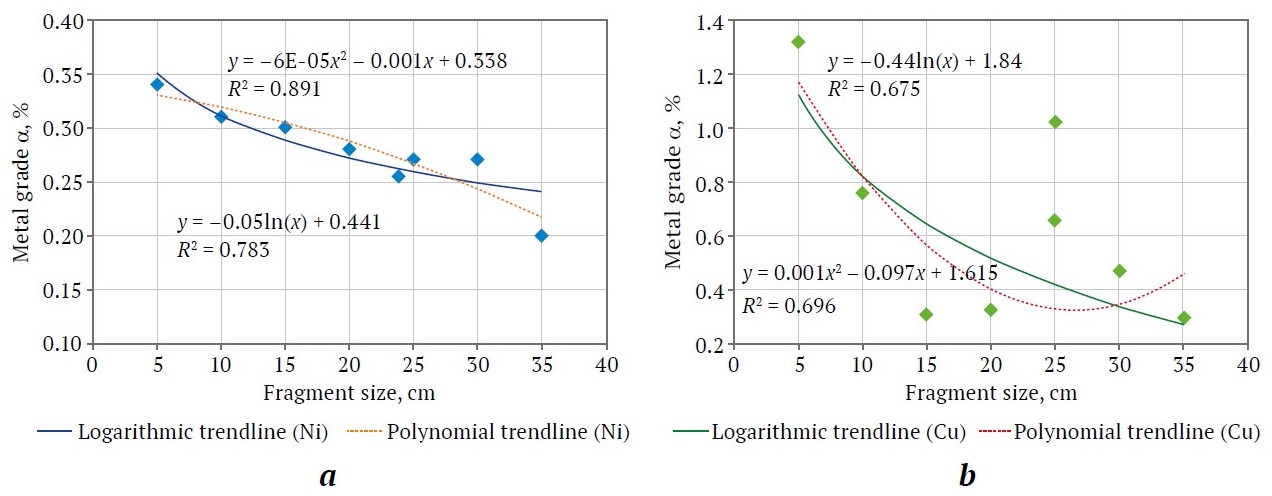
Fig. 5. Inverse relationship between blasted ore fragment size and nickel (a) and copper (b) grades
In mining practice, an ore pass is often regarded as an effective underground blending facility. During the extraction of disseminated ores in particular, however, an ore pass may cause deblending because of particle-size segregation within the mined material. Particle-size segregation of the rock-ore material during development of a copper-nickel ore deposit arises from the inverse relationship between the size of the blasted ore fragments and their metal grades (Fig. 5). Field investigations of the ore stream were conducted to examine this segregation phenomenon. The sampling scheme included sampling of the muckpile, carbycar sampling of each ore train on the haulage levels, and sampling of ore from the bucket of a load-hauldump machine (LHD). During the observation period, 1.926 thsd t of ore passed through the haulage-level workings. Thus, as the ore fragment size in the muckpile decreased from 350 to 50 mm, the nickel grade in the mined ore increased from 0.19 to 0.34%, while the copper grade increased from 0.22 to 1.30%.
Analysis of the identified statistical relationship demonstrates the need for new mine design and process engineering solutions for copper-nickel ore quality management. These solutions should ensure stable average metal grades in the segregated mined material delivered to the concentrator.
3 Regulations on month-ten‑day‑period‑day‑shift mine planning by the Planning Center at the Komsomolsky Mine. Norilsk; 2019. 10 p. (In Russ.)
Strategy for the development of sulfide and copper‑nickel ore deposits of the Talnakh ore cluster and the Norilsk‑1 deposit by the mining enterprises of the mineral resource complex of the Polar Division of OJSC MMC Norilsk Nickel. Mining Administration, Polar Division of OJSC MMC Norilsk Nickel. Norilsk; 2013. (In Russ.)
An assessment of the complexity of orebody occurrence at the Norilsk copper-nickel deposits showed that the deposits do not fall into the complex category (λ = 0.01–0.5). However, mining conditions deteriorate as the orebody occurrence complexity index increases. Consequently, the predicted ore loss and dilution rates for individual mining units increase, thereby reducing ore recovery during mining and widening the discrepancy between planned and actual mining performance under the changed mining conditions [7].
To investigate changes in ore quality parameters along the ore stream, Micromine was used to calculate indices of ore quality variability during mining operations (Table 1). The results indicate that metal grades in the ore output will be unstable as the ore is blasted in the stope through successive blast-hole rings.
Table 1
Statistical indices of ore quality variability
| Variability indices in the stope orebody according to the mine design | Predicted indices of process-induced variability during blasting in the stope | ||
| Ni | Cu | Ni | Cu |
| Coefficient of variation, ν, % | |||
| 64.76 | 41.08 | 89.24 | 51.01 |
The standard deviations of nickel and copper grades attributable to within-block variability were predicted to exceed 0.41 and 0.55%, respectively. The production-scale investigations therefore showed that the composition of the mined material is partially destabilized at individual stages of the production chain, reducing the overall grade-stabilization capacity of the mine flowsheet.
For example, particle-size segregation during the transfer of mined material through ore passes causes deblending, that is, separation by particle size, and reduces the blending coefficient. Thus, segregation of the mined ore disrupts the natural grade-stabilization effect of the mine flowsheet while simultaneously creating favorable conditions for separation technologies. The higher the ore contrast index, the more favorable the conditions for separation and, consequently, for the use of underground segregation-based technologies [8]. In-mine investigations were conducted to determine ore contrast. Under the conditions of the Norilsk underground mines, rock-ore fragments within the specified size range were classified as having low contrast at M = 0.4–0.8 and moderate contrast at M = 0.8–1.1. Despite the relatively low contrast of the Norilsk ores, computer modeling of preconcentration of the mineral components in the mined ore was performed [2, 9]. Numerical modeling and statistical processing of the test data were carried out using STATISTICA 10.0 and Microsoft Office Excel. The modeling results showed that this solution reduces the volume of saleable ore by 36% by removing lower-grade fractions from the total mined material. As a result, the average nickel grade in the preconcentrate increases by 63% relative to the feed, from 0.26 to 0.41%, that is, by more than 1.5 times. The average copper grade in the preconcentrate increases from 0.38 to 0.60%, corresponding to an absolute increase of 0.22 percentage points, at a metal recovery of 94%.
The integrated study showed that sulfide ores within the Norilsk underground mining area are heterogeneous in terms of valuable-component grades, modes of occurrence, spatial distribution, and orebody structure [10]. Because the ore deposits of the Norilsk mineral resource complex exhibit high natural variability in in-situ ore quality characteristics (σ = 0.07–1.40; v = 39.30–111.50), they may be regarded as geologically complex from the standpoint of maintaining a stable mineral composition of the ore during underground mining. Therefore, the conceptual basis for developing underground systems for copper-nickel ore quality management should incorporate an updated set of methods and models. Their use in mine design and process engineering decision- making can improve the quality of the mined material despite the rapid deterioration in the quality of commercially mineable reserves of the principal ore types.
The range of ore quality fluctuations within the ore streams can be reduced most effectively within the underground mining system. For example, after blasting, the range of variation in the quality characteristics of blasted disseminated ore is smaller at the production face and in LHD buckets than in rail cars. One of the principal causes of ore quality destabilization during the extraction of disseminated ores is the use of a caving method, for which ore loss and dilution rates reach 15–20% or more. Another cause is natural particle-size segregation during underground mining operations and material-handling processes.
Under mine operating conditions, particle-size segregation should therefore be considered as a phenomenon that can be used beneficially to increase the grade of valuable components in the mined ore by rejecting waste rock and part of the subeconomic ore at the mining stage.
It should be taken into account that, under actual underground mining conditions, in-mine preconcentration is expected to reduce the ore tonnage delivered to the processing plant by more than 50%. The in-mine preconcentration model also did not account for the decrease in metal grades in the mined material from the production face to the surface or the resulting decline in ore-grade contrast. Consequently, when copper-nickel ores exhibit relatively low grade contrast, the use of preconcentration alone within the mine production chain is unlikely to achieve adequate throughput.
For complex-structured orebodies, a promising approach should therefore combine separation with the controlled addition of subeconomic ore from the orebody contact zone. As demonstrated in [11], accounting for the exponential decline in valuable-component grades within the contact zone provides a sound basis for incorporating part of the subeconomic ore into the main ore stream without reducing concentrate quality, thereby increasing the overall recovery of the ore reserves. Accordingly, optimization of technologies intended to improve ore quality requires an integrated solution aimed at establishing a combined production quality management system that accounts for segregation of the mined material. The studies described above therefore provide a basis for formulating the fundamental principles underlying process engineering solutions incorporated into underground mine designs for copper-nickel ore quality management [12, 13].
A classification of equipment and methods for ore grade stabilization, including their respective indices and operating principles, was proposed in [12]. A substantial natural blending effect was shown to occur when mined ore is stored in stockpiles, ore passes, or bins [5, 14]. On this basis, the present study recommends converting the underground mine crushing and storage complex into a blending and stabilization facility with a predicted blending coefficient of Kβ = 1.6–2.8 (Fig. 6). The underground ore-stream quality management system is designated as 1 – А – А7 – 2 – В – В14. This designation indicates that, at the first management stage, organizational measures are implemented to establish the target average ore quality in specified quantities of mined ore through real-time mine planning and hourly intrashift control. At the second management stage, production and process engineering measures ensure the uniform distribution of the established average metal grades throughout the mine-wide ore stream through the use of a specially designed stockpile-based blending facility [4].
The overall underground ore quality management system should include an information and control architecture comprising two subsystems: an information subsystem for real-time ore quality management and a production and process engineering subsystem (Fig. 7).

Fig. 6. Flowsheet of the underground ore-stream quality management system

Fig. 7. Model of the information and control architecture of the underground ore quality management system during mining
The production and process engineering subsystem has a conventional configuration and encompasses the organization of production operations and processes required for mining. By contrast, the modern real-time information and control subsystem must be developed substantially anew using radiometric and electronic equipment functionally and structurally integrated into the mine production chain. This subsystem should provide centralized real-time monitoring of metal grades throughout the mining process: at the production faces; upstream and downstream of ore passes; in rail cars on haulage levels; in skips before hoisting; and in bins, material-transport streams, and stockpiles. Ore quality monitoring stations may be used for this purpose [15, 16].
Introducing real-time ore quality monitoring equipment into mining operations and integrating it into a unified underground mine production system will accelerate data processing, analysis, and operational response by improving the mobility and access to information of engineering and technical personnel. This will, in turn, improve real-time intrashift planning and control over production processes aimed at meeting the planned ore quality and production-volume targets.
To ensure the long-term security of the mineral resource base of the Norilsk mines, the fundamental principles of the strategic approach to optimizing process engineering solutions for copper-nickel ore quality management in underground mining should be reconsidered.
As the Norilsk deposits are progressively depleted and ore quality variability increases during underground mining of copper-nickel ores, improvements in mined ore quality require an innovative and integrated approach. This approach should involve modernization of mine flowsheets through the combined use of blending and stabilization methods and segregation- based separation methods for ore quality management during mining.
Underground mines should make use of their available process capacity for blending the mined material in order to manage product quality. The most promising option is to locate blending and stabilization facilities at the surface, at the end of the mine production chain.
Under specific mine conditions, particle-size segregation should be used beneficially to reject the low-quality fraction from the total mined material and increase the grade of valuable components in the ore streams.
Ore quality management during mining should be implemented as a multistage process. Accordingly, the information and control subsystem of a modern underground mine should be upgraded to provide mine management personnel with data on changes in ore quality variability parameters throughout the mining process, from the working face to the surface. Digitalization of data flows in mine production management will create an integrated information environment and ensure the transparency and accessibility of reliable ore quality data. These data provide the basis for process engineering solutions incorporated into mine designs to increase metal recovery by stabilizing grades in the mill feed.
A comprehensive basis for mine design and process engineering solutions aimed at optimizing the formation and stabilization of mined ore quality is provided by establishing a combined production quality management system in the underground mine. Such a system should account for segregation of the mined material and incorporate underground preconcentration technology to increase the grade of valuable components in the mined ore.
The fundamental principles developed from the research findings and engineering studies provide a conceptual basis for mine design solutions incorporating innovative modernization of process flowsheets and optimization of underground systems for copper-nickel ore quality management. This approach can improve the economic performance of the entire mining and metallurgical complex of the Norilsk industrial region.
1. Batraliev R. Sh., Okhrimenko A. V., Turtygina N. A. Conceptual structure of on-line information and control system toward stabilization of ore flow quality. Gornyi Zhurnal. 2022;(10):91–96. (In Russ.) https://doi.org/10.17580/gzh.2022.10.14
2. Kozhiev Kh. Kh. Mine quality management systems for mineral raw materials. Lomonosov G. G. (Ed.) Moscow: Publ. House of Moscow State Mining University (MSMU); 2005. 292 p. (In Russ.)
3. Rayo J. D., Mercado J. M., Encina V. Simulation of block caving operation using a discrete element method (DEM). In: Mining 2016 – 6th International Conference on Innovation in Mine Operations. Santiago, Chile, August 21–23, 2016.
4. Lane K. F. The economic definition of ore, cut-off grades in theory and practice. 2nd ed. London: Mining Journal Books Limited; 1997. 147 p.
5. Oggeri C., Fenoglio T.M., Godio A., Vinai R. Overburden management in open pits: options and limits in large limestone quarries. International Journal of Mining Science and Technology. 2019;29(2):217–228. https://doi.org/10.1016/j.ijmst.2018.06.011
6. Oggeri C., Oreste P. Underground quarrying for marble: stability assessment through modelling and monitoring. International Journal of Mining Science. 2015;1(1):35–42.
7. Turtygina N. A., Okhrimenko A. V., Sharov S. A., Frolov N. A The influence of the geological structure of Norilsk deposits on the level of stability of the material composition of the ore mass during underground mining. Scientific Bulletin of the Arctic. 2024;(16):70–79. (In Russ.) https://doi.org/10.52978/25421220_2024_16_70–79
8. Turtygina N. A., Okhrimenko A. V. Quantitative assessment of natural variation in quality of copper ore in roof of intrusion. Mining Informational and Analytical Bulletin. 2019;(8):146–156. (In Russ.) https://doi.org/10.25018/0236-1493-2019-08-0-146-156
9. Fowler A. C., Scheu B. A. Theoretical explanation of grain size distributions in explosive rock fragmentation. Proceedings of The Royal Society A: Mathematical, Physical and Engineering Sciences. 2016;472(2190):20150843. https://doi.org/10.1098/rspa.2015.0843
10. Rakishev B.R., Edil'baev A.I., Orynbay A.A., Ibyrkhanov T.S. Variation of ore grades in the boundary zone of subeconomic ore. Mining Science and Technology (Russia). 2025;10(3):205-220. https://doi.org/10.17073/2500-0632-2025-04-395
11. Miroshnikova L. K. Minerals of sulfide copper-nickel platinum-bearing ores of the Norilsk-Talnakh group of deposits. Monograph dedicated to the 100th anniversary of the discovery of the sulfide copper-nickel platinum-bearing ore deposit "Norilsk-1". Norilsk: Cactus; 2019. 147 p. (In Russ.)
12. Turtygina N. A., Okhrimenko A. V., Frolov N. A. Classification of ways to stabilize the ore flow quality in underground mining. Racionalʹnoe Osvoenie Nedr. 2023;(4):32–40. (In Russ.) https://doi.org/10.26121/RON.2023.51.61.002
13. Calas G. Mineral resources and sustainability development. Elements. 2017;13(5):301–306. https://doi.org/10.2138/gselements.13.5.301
14. Cleary P. W., Sawley M. L. DEM modelling of industrial granular flows: 3D case studies and the effect of particle shape on hopper discharge. Applied Mathematical Modelling. 2002;26(2):89–111. https://doi.org/10.1016/S0307-904X(01)00050-6
15. Pavlishina D.N., Shumilov P.A., Tereshchenko S.V. Development of the software module "Ore Quality Management". In: Collection of Scientific Papers of KF PetrSU. Apatity: Publishing House of KF PetrSU; 2015. Pp. 27–30. (In Russ.)
16. Makarov V. A., Malinovsky E. G., Katser I. I. et al. Intelligent technology for monitoring and quality management of ore flows in mining and processing of multicomponent ores. Monograph. Krasnoyarsk: SFU; 2016. 146 p. (In Russ.)
Natalia A. Turtygina – Cand. Sci. (Eng.), Associate Professor of the Department of Mineral Deposit Development
Norilsk
Scopus ID 57206659384
Alexander V. Okhrimenko – Head of the Planning Center, Komsomolsky Mine
Norilsk
Aleksey V. Glinsky – Mining Engineer (First Category) of the Technical Department, Oktyabrsky Mine
Norilsk
Kirill A. Ryzhenkov – PhD Student of the Department of Mineral Deposit Development
Norilsk
Turtygina N.A., Okhrimenko A.V., Glinsky A.V., Ryzhenkov K.A. Mine design and process engineering solutions for copper-nickel ore quality management in underground mining. Mining Science and Technology (Russia). 2026;11(2):130-140. https://doi.org/10.17073/2500-0632-2025-07-1003




Editor-in-Chief
Petrov V.L. Email this article (Login required)
Email the author (Login required)
Email this article (Login required)
Email the author (Login required) 119049, Moscow, Leninsky Prospect, 4, b. 1
The National University of Science and Technology MISIS (NUST MISIS)
Tel.: +7 (968) 848-61-24
E-mail: send@misis.ru





