


Contents
Scroll to:
https://doi.org/10.17073/2500-0632-2025-08-1022
Scroll to:
As ventilation networks in modern mines expand, airflow distribution control becomes increasingly complicated due to three factors: insufficient control depth combined with unsynchronized operating schedules of individual mine sectors; increasingly complex aerodynamic interactions between working areas and control devices; and growing system inertia. This highlights the need for a unified approach to designing ventilation control systems for complex networks, so that the conditions under which their implementation is technically feasible and economically justified can be assessed in advance. To achieve this objective, two key tasks were addressed: identifying the appropriate spatial depth and temporal scale of ventilation control. The methodology was based on a mathematical framework for analyzing aerodynamic interactions in branched networks with numerous fans, shafts, levels, and diagonal connections. The framework includes the use of aerodynamic influence matrices, their graphical analysis, clustering, and decomposition of the network into subsystems. Dimensional analysis was also applied to estimate the characteristic times of various dynamic processes in mines. As a result, principles for designing control systems were proposed, including the selection of the control level with regard to the number of air consumers and their operating schedules, as well as matching the control time scale to the characteristic times of ventilation and mining processes. It was shown that the duration of production cycles permits ventilation control to be applied at that level, opening a promising direction for further research. It was also established that, in complex ventilation networks, control algorithms should be designed primarily to maintain the required airflow rate, whereas control based on gas concentration is less effective.
Levin L.Yu., Semin M.A., Maltsev S.V., Zaitsev A.V. Methodological framework for designing ventilation control systems for complex mine ventilation networks. Mining Science and Technology (Russia). 2026;11(1):70-79. https://doi.org/10.17073/2500-0632-2025-08-1022
Introduction
As large mineral deposits are developed, mine ventilation networks tend to become highly branched over time. They may include several hundred or even thousands of mine workings, numerous working areas, underground levels, and pressure sources. As the network expands, the nonproductive use of fresh air, that is, so-called air leakage, also increases. Delivering the required volume of fresh air to each working area becomes progressively more difficult, while ensuring this in an energy-efficient manner becomes even more challenging. As a result, mine ventilation costs steadily increase with mining depth, the expansion of the workings network, and rising production rates. Under such conditions, the share of power consumption attributable to ventilation may reach 50% of the total energy used in mining operations [1–3]. Ventilation thus becomes such a costly production process that its optimization can no longer be neglected if a mining enterprise intends to remain profitable.
The number of shafts in mines is usually minimized for economic reasons. However, their air-carrying capacity is limited by the permissible air velocity, which, according to safety regulations, must not exceed 15 m/s. This naturally reduces the maximum allowable airflow through shafts and, in turn, requires more rational and efficient air distribution throughout underground workings.
Energy-efficient ventilation of underground mines requires the use of airflow control systems. The most widespread of these is ventilation on demand (VoD), which provides dynamic adjustment of air supply depending on the current operating conditions [4, 5]. For each shift, a required airflow rate is specified, and the system achieves it by varying the rotational speed of the main fans, adjusting the door opening, and using other control means. This approach has proven effective in relatively small mines with one or several working areas. In such cases, it is generally possible to rely on fairly simple control algorithms for fan installations and ventilation doors.
However, in branched ventilation networks serving numerous air consumers, the effective use of ventilation control systems remains an open issue. There are known cases where simple control schemes that distribute airflow only among the main mine districts fail to deliver appreciable energy savings [6]. This is primarily due to insufficient control depth and the limited overlap between the operating schedules of development and production districts. In this context, control depth refers to the hierarchical level at which ventilation regulators are installed, that is, the extent to which ventilation doors are positioned beyond the shaft station and the main drifts to redistribute airflow among individual sectors of the network. For example, in the Verkhnekamsk potash mines, if ventilation doors are installed only on the main ventilation drifts near the shaft station and regulate only the overall airflow by direction, the system cannot accurately redistribute airflow among panels and blocks within the same direction. Consequently, a significant portion of the potential benefit is lost.
The growing complexity of airflow distribution control in developing ventilation networks cannot be explained by this factor alone. Two additional aspects are also of major importance.
First, aerodynamic interactions between working areas and control devices become increasingly complex. In practice, a ventilation network cannot always be represented as a simple system of several parallel airways, each controlled by a separate fan or door. Working areas are often connected in series or by diagonal links, so that a single control device may affect several air consumers to different extents [7].
Second, ventilation system inertia increases. The greater the total length of the main ventilation airways and the more complex the network, the longer it takes for a new airflow distribution to become established after the control settings have been changed. This limits the performance of the control system, which must operate on a time scale consistent with the transition of the network to a new steady state. In large networks, the control system is physically unable to respond to short-term fluctuations in airflow rate or gas concentration; such variations must therefore remain outside the control range.
This raises an important question: can a unified approach be developed for designing ventilation control systems in complex networks that would make it possible to assess in advance the conditions under which their implementation would be technically feasible and economically justified? Addressing this question requires a conceptual reappraisal of ventilation control, especially in mines with complex ventilation networks. In the present study, complexity is understood specifically in terms of controllability, that is, the presence of one or more of the following factors:
The aim of this study is to develop and substantiate methodological principles for designing ventilation control systems for complex mine ventilation networks while accounting for these factors.
To achieve this aim, two key objectives must be addressed:
The first objective concerns the placement of negative regulators at underground levels. The key question is where they should be installed in order to exert a significant influence on airflow in the working area and, ultimately, to enable the system to achieve appreciable power savings.
Whereas the first objective relates to the spatial structure of the network, the second concerns its dynamics. More specifically, it requires estimating the characteristic times of unsteady aerological processes and comparing them with the response time of the control system.
Some dynamic processes are so rapid that they cannot be regulated by means of ventilation doors or fans, as any such attempt would destabilize the system. These include gas emission from the rock mass [8], the aerodynamic effects produced by moving mining equipment [9], and similar phenomena. Other processes are much slower, for example thawing of the rock mass [10], for which periodic manual adjustment of ventilation windows, once a week or once a month, is sufficient. It is therefore essential to identify processes whose duration is comparable to, but not shorter than, the response time of the control system and to use them as the basis for automatic regulation.
The development of a unified approach to mine ventilation control systems has been discussed in earlier studies. Significant contributions were made in [11–13], which established the theoretical foundations for automated airflow distribution control. In particular, [11] introduced the term automated ventilation control system. The authors of [12] were the first to emphasize the need to account for the different inertia of aerodynamic and gas-dynamic processes arising from different rates of disturbance propagation, and they also proposed a classification of ventilation networks into easy-to-control and difficult-to-control systems. In [13], an optimality criterion for ventilation network control was formulated, and methods for solving the corresponding optimal control problem were proposed.
The present study builds on the definition of complex ventilation systems proposed by S. V. Maltsev1, while substantially extending it in the context of control tasks.
It should also be noted that the above studies considered optimal airflow distribution control primarily through computer models of ventilation networks. The present study, by contrast, focuses on the application of automatic control theory. Thus, despite the extensive theoretical foundation already available, the methodology for designing ventilation control systems for mines with complex ventilation networks has not yet been addressed as a distinct subject in its own right.
1 Maltsev S. V. Research and development of methods for determining the aerodynamic parameters of complex ventilation systems in underground mines. [Diss. ... Cand. Sci. (Eng.)] Perm; 2020. 148 p. (In Russ.)
Determining the spatial depth of ventilation control
Ventilation networks in modern mines are highly branched structures in which the airflow is split not once or twice, but many times. This is especially evident in potash mines (Fig. 1), where a central ventilation system is typically used.

Fig. 1. Fragment of the ventilation network of a potash mine in the Verkhnekamsk deposit
(generated using the Aeroset software package)
Air entering through the intake shaft is first distributed among the main mine districts, then routed into the intake panel drifts, including the haulage and conveyor drifts, and subsequently into the block workings. If ventilation doors are installed only on the return drifts of the main directions, it becomes impossible to regulate airflow distribution among the individual branches within those directions, that is, at the panel and block levels.
This is due to the mining method used. At the Verkhnekamsk deposit, room-and-pillar mining with mechanized extraction by continuous miners is employed. Under these conditions, many production faces, often several dozen, operate simultaneously in different panels and on asynchronous schedules. On average, downtime at each face may reach 10 h per day. However, because a single ventilation door supplies air to several faces at once, it is practically impossible to reduce the total airflow rate in the mine [6].
By contrast, installing doors at every panel within a given direction would substantially increase their number and, consequently, the cost of implementing the ventilation control system. In addition, doors would have to be installed on all parallel branches, that is, all panels within that direction, in order to eliminate parallel aerodynamic connections. Otherwise, air would short-circuit through the branch not equipped with a flow-restricting device, effectively reducing the potential energy-saving effect to zero.
Thus, the placement of ventilation doors should be determined with reference to two key factors:
If the number of consumers is large and their schedules are substantially out of phase, appreciable power savings are unlikely to be achieved. In such cases, the doors should be installed one hierarchical level lower, after the next airflow split into individual sectors, and the number of air consumers served by each automatic door should then be reassessed.
Ideally, one ventilation door should serve one consumer. In practice, however, this is not always feasible because of the large number of working areas, their high mobility, the rapid advance of the mining front, continual changes in active locations, and the influence of additional disturbing factors near individual working areas, such as auxiliary fans or moving mining equipment. Accordingly, identifying a compromise solution usually requires comparing the capital cost of installing ventilation doors with the savings in operating costs achieved through lower fan power demand.
This situation is not typical of the potash mines of the Starobin deposit, where longwall mining with caving is predominantly used. In the main directions of the ventilation networks at these mines, there are relatively few high-capacity working areas, namely longwalls, which makes it possible to achieve substantial power savings [5].
A different situation arises when ventilation control systems are designed for mines with a flank ventilation system. Examples include the copper-nickel mines in northern Krasnoyarsk Krai, which typically have 5–7 shafts, 2–4 main fan installations, and numerous underground levels. Fig. 2 shows the ventilation network of one such mine, including three main fans, seven shafts, and more than ten underground levels.

Fig. 2. Ventilation network of a copper-nickel mine in Krasnoyarsk Krai
Whereas in mines with a central ventilation system the topological relationship between individual air consumers and ventilation doors can still be identified with reasonable clarity, in mines with a flank ventilation system it becomes much more difficult to trace airflow paths, determine which workings exert the strongest influence on particular air consumers, and establish where ventilation doors should be installed.
This complexity is primarily due to the large number of ventilation raises, inclines, connecting ramps, and other workings that create numerous diagonal connections and make the overall airflow pattern difficult to interpret. In this context, it is difficult to determine the required control depth and the corresponding arrangement of ventilation doors across underground levels.
To solve this problem, the present study proposes the use of aerodynamic influence matrices. These matrices make it possible to quantify how a change in the -th control parameter affects the airflow rate at the -th consumer.
If a tentative set of ventilation doors has been selected and the suitability of their locations needs to be assessed, an aerodynamic influence matrix may be calculated in the form

where R0j is the initial aerodynamic resistance of the j-th door, Н∙s2/m8; Q0i is the initial airflow rate at the -th consumer, m³/s; ΔQi is the change in the total airflow rate at the -th consumer in response to a change in the resistance of door , m³/s; ΔRj is the change in door resistance, N·s²/m⁸.
The coefficients of the aerodynamic influence matrix in Eq. (1) make it possible to identify which ventilation doors have a strong effect on the airflow rate at a given air consumer while causing only minimal disturbance elsewhere in the network. This is determined by both the magnitude and the sign of the corresponding matrix elements.
A similar matrix may be constructed to evaluate the effect of the main fan installations on the airflow rates at the air consumers:

where n0j is the initial impeller rotational speed of the -th fan installation, rpm, and Δnj is the change in the impeller rotational speed of the -th fan installation, rpm.
Mathematically, Eqs. (1) and (2) represent the Jacobian of the ventilation network. They are closely related to the sensitivity matrices used in stability analysis of mine ventilation networks [14, 15], but in this case they are expressed in normalized dimensionless form, which allows direct comparison of matrix elements for workings with substantially different airflow rates.
These matrix coefficients are not fixed; rather, they depend on the initial airflow rates Q0i, aerodynamic resistances R0j, and fan rotational speeds n0i. Consequently, if the mine ventilation regime for which matrices (1) and (2) were derived changes substantially, their numerical values may also change appreciably. In addition, qualitative changes may occur, especially in parts of the network containing diagonal connections, reflecting the variable nature of aerodynamic interactions and highlighting potentially vulnerable zones susceptible to ventilation instability.
The corresponding matrix was constructed to assess the effectiveness of the selected ventilation-door locations in the copper-nickel mine shown in Fig. 2. For six aggregated air consumers, that is, mining districts comprising several working areas, matrix (1) identified the ventilation doors with the greatest influence on their ventilation (Fig. 3).
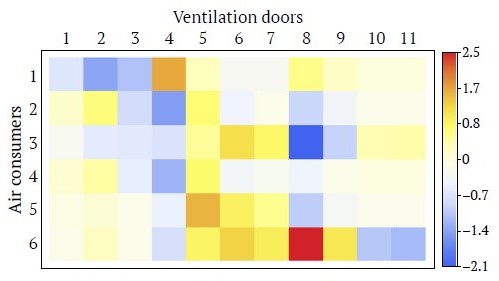
Fig. 3. Aerodynamic influence matrix for air consumers (production districts) in the copper-nickel mine
The blue and light-blue cells correspond to cases where Iij < 0, that is, where an increase in ventilation-door resistance leads to a decrease in the airflow rate at the given consumer. At the same time, the matrix also contains elements for which Iij > 0. In such cases, increasing door resistance causes the airflow rate to increase at some air consumers located on airways parallel to the corresponding door.
The ventilation door exerting the strongest negative influence was identified for each air consumer. This information was then used to assign control functions among the doors so as to ensure the required airflow rate at each consumer.
An approach of this kind, conceptually close to clustering methods widely used in data analysis, often reveals distinct clusters in the matrices, that is, groups of air consumers and doors that are closely interconnected but only weakly connected to the rest of the mine. In such cases, the control system of a complex mine can be organized as several mutually independent subsystems, which greatly simplifies its practical implementation.
Such clusters can be identified, for example, by introducing a threshold value for |Iij| (Fig. 4). Once all cells with values below this threshold are removed, it becomes clear which ventilation doors should be assigned to control which air consumers. At the same time, the need for some doors may be called into question, as in the case of doors 1, 7, and 9 in the mine considered here.

Fig. 4. Binarized aerodynamic influence matrix for air consumers in the copper-nickel mine
This matrix-based approach was applied in the development of ventilation control systems for three copper-nickel mines in Krasnoyarsk Krai. Because these mines use full-seam mining combined with drill-and-blast development, work shifts are highly synchronized. This makes it possible to distinguish several relatively large districts containing multiple working areas; in the mine considered above, six such districts were identified (see Figs. 3 and 4). In such cases, dynamic intrashift airflow distribution control can deliver substantial average daily energy savings, which ranged from 10.9 to 20.1% across the three mines studied.
Aerological processes in the mine atmosphere are inherently unsteady and differ substantially in their characteristic time scales.
Fast processes. The fastest processes, such as the passage of a shock wave during drilling-and-blasting operations or methane outbursts, as well as the propagation of an acoustic wave during the rapid opening or closing of stoppings, are characterized by the following time scale:

where 𝐿 is the length of the main airway in the ventilation network, m, and is the speed of sound in air, m/s. For 𝐿 = 10 km, this gives τ ≈ 30 s.
On such a short time scale, the airflow distribution in the network obviously cannot reach a steady state. Establishing a new distribution requires the repeated passage of acoustic disturbances [16]. The characteristic time required for the ventilation network to reach a steady airflow distribution can be estimated using the equation proposed in [17]:

where ρ is the air density, kg/m3; S is the cross-sectional area of the working, m2; Q is the airflow rate, m3/s; H is the pressure drop, Pa; R is the aerodynamic resistance, N∙s2/m8.
In this case, the characteristic time

is on the order of tens of minutes.
Intermediate time scales. The characteristic times of production cycles depend on the specific type of operation. They may be on the order of:
In the general case, the time parameter τ3, which reflects the cyclicity of production operations in working areas, should be determined individually. The same applies to τ4, which characterizes shift duration (production, maintenance, or shutdown).
Slow processes. The longest-term variations are associated with thermal processes in the rock mass, including thawing, as well as seasonal changes in natural ventilation pressure, and may persist for weeks or months. Their characteristic time may be estimated from [18] as:

where R is the characteristic transverse dimension of the mine working, typically on the order of several meters, m, and a is the thermal diffusivity of the rock (≈ 10−6 m2/s).
Associated unsteady processes. Other processes also occur in mines, including the release of dust, methane, and hydrogen sulfide from the rock mass, as well as emissions from diesel-powered equipment. Their temporal behavior is sometimes correlated with equipment operation, but in many cases follows a different pattern. For example, gas emission from the rock in potash and coal mines may vary over time as a result of random processes, with characteristic fluctuation times on the order of minutes [8, 11].
This raises an important question: which parameter should be used to control ventilation doors and fans? Some authors [19–21] propose relying on direct gas analyzer readings at the working face. However, in mines with complex ventilation networks, this approach may be impractical because many gas-emission processes vary on time scales much shorter than the response time of the control system. In such cases, a more reliable control criterion is compliance with the required airflow rates determined in accordance with approved procedures. Since these values are relatively stable over time, they can serve as a sound basis for the design of automated ventilation control systems.
Thus, all unsteady processes occurring in mine ventilation networks can be classified according to their characteristic times. This makes it possible to place them on a common time scale together with the characteristic response time of the ventilation control system, τу. The response time, however, should not be shorter than τ₂, the time required for a steady airflow distribution to become established after changes have been introduced into the network (Fig. 5).

Fig. 5. Characteristic time scales of the main processes and control response time
Within this time scale, it is possible to identify the range of characteristic times over which unsteady processes can and should be regulated by the ventilation control system. Processes whose time scales fall outside this range are either not amenable to effective control or are not worth regulating from an economic or operational standpoint.
Fig. 5 shows, in particular, that the primary objects of control are production processes associated with operations in working areas, as well as transitions between different shift states, namely production, maintenance, and shutdown. The latter, referred to as dynamic intershift control [22], most often serves as the basic implementation level of ventilation on demand in mines. It is based on fixed setpoints, that is, airflow rates specified at the dispatcher workstation and usually assumed to remain unchanged within each shift. This approach ensures a high level of reliability and operational stability, as repeatedly confirmed in practice [5, 23, 24].
At the same time, processes characterized by the time scales of production cycles within a shift, such as vehicle entry and exit, truck loading and unloading, and similar operations, may also be sufficiently long to permit regulation in some cases. This opens up a promising avenue for future research, namely the development of intrashift ventilation control methods. Their implementation would increase the flexibility of ventilation-on-demand systems, better align air supply with the actual pattern of production operations, and thereby create additional potential for energy savings.
The main scientific and practical findings of the study can be summarized as follows.
1. de Souza E. Cost saving strategies in mine ventilation. CIM Journal. 2018;9(2).
2. de Vilhena Costa L., da Silva J. M. Cost-saving electrical energy consumption in underground ventilation by the use of ventilation on demand. Mining Technology: Transactions of the Institutions of Mining and Metallurgy. 2020;129(1):1–8. https://doi.org/10.1080/25726668.2019.1651581
3. Pinsker O. V., Mukhortikov S. G., Kvitkov V. V. et al. Evaluation of the efficiency of fan speed control of local ventilation of coal mines. Mining Equipment and Electromechanics. 2024;(4):27–36. (In Russ.) https://doi.org/10.26730/1816-4528-2024-4-27-36
4. Acuña E. I., Alvarez R. A., Hurtado J. P. Updated ventilation on demand review: implementation and savings achieved. In: Proceedings of the 1st International Conference of Underground Mining. October 19–21, 2016, Santiago, Chile.
5. Semin M. A., Grishin E. L., Levin L. Y., Zaitsev A. V. Automated ventilation control in mines. Challenges, state of the art, areas for improvement. Journal of Mining Institute. 2020;246:623–632. (In Russ.) https://doi.org/10.31897/PMI.2020.6.4
6. Bublik S. A., Zaitsev A. V., Maltsev S. V., Semin M. A. Analysis of the efficiency of dynamic ventilation control systems in potash mines. Gornoe Ekho. 2021;(3):81–89. (In Russ.) https://doi.org/10.7242/echo.2021.3.15
7. Kozyrev S. A., Osintseva A. V. Optimizing arrangement of air distribution controllers in mine ventilation system. Journal of Mining Science. 2012;48(5):903–910. https://doi.org/10.1134/S1062739148050153 (Orig. ver.: Kozyrev S. A., Osintseva A. V. Optimizing arrangement of air distribution controllers in mine ventilation system. Fiziko-Texhnicheskiye Problemy Razrabbotki Poleznykh Iskopaemykh. 2012;(5):135–143. (In Russ.))
8. Brady D. The role of gas monitoring in the prevention and treatment of mine fires. In: Aziz N. (Ed.) Coal 2008: Coal Operators' Conference. University of Wollongong & the Australasian Institute of Mining and Metallurgy; 2008. Pp. 202–208.
9. Levin L., Semin M., Maltsev S. et al. Numerical analysis of the impact of variable borer miner operating modes on the microclimate in potash mine working areas. Computation. 2025;13(4):85. https://doi.org/10.3390/computation13040085
10. Hoholov Y. A., Solovyev D. E. The temperature schedule of everfrost rock mass during drifting works. Mining Informational and Analytical Bulletin. 2009;(4):177–182. (In Russ.)
11. Puchkov L. A., Bakhvalov L. A. Methods and algorithms for automatic ventilation control in coal mines. Moscow: Nedra; 1992. 399 p. (In Russ.)
12. Mester I. I., Zasukhin I. N. Automation of monitoring and control of mine ventilation. Moscow: Nedra; 1974. 240 p. (In Russ.)
13. Tsoi S.V. Automatic control of mine ventilation systems. Alma-Ata: Nauka; 1975. (In Russ.)
14. Hu L. M., Jiang S. G., Dong S. B. Selection and application of ventilation system’s sensitive branches based on the sensitivity. Advanced Materials Research. 2014;1010–1012:1471–1474. https://doi.org/10.4028/www.scientific.net/AMR.1010-1012.1471
15. Zhou L., Bahrami D. A derivative method to calculate resistance sensitivity for mine ventilation networks. Mining, Metallurgy & Exploration. 2022;39(4):1833–1839. https://doi.org/10.1007/s42461-022-00630-z
16. Zhou A., Wang K. A transient model for airflow stabilization induced by gas accumulations in a mine ventilation network. Journal of Loss Prevention in the Process Industries. 2017;47:152–160. https://doi.org/10.1016/j.jlp.2017.03.006
17. Kazakov B., Shalimov A., Grishin E. Modeling moving air nonstationary processes and diffusion heat and admixtures on tunnels ventilation jets with using program complex "Aeronetwork". Izvestija Tulskogo Gosudarstvennogo Universiteta. Nauki o Zemle. 2010;(2):64–69. (In Russ.)
18. Galkin A. F. Calculation of the Fourier criterion in predicting the thermal regime of thawed and frozen dispersed rocks. Arctic and Antarctica. 2022;(3):1–10. https://doi.org/10.7256/2453-8922.2022.3.38555
19. Puchkov L., Kaledina N. Methane dynamics in mined-out areas of mines. Moscow: Moscow State Mining University; 1995. 313 p. (In Russ.)
20. Jahir T., Mohamed M. Using gas monitoring and personnel & vehicle tracking to maximize the benefits of ventilation-on-demand in underground mining operations. Conspec Controls Limited; 2011. 7 p.
21. Kashnikov A. V., Kruglov Yu.V. Fuzzy logic-based determination of ventilation parameters in active mining areas. Mining Informational and Analytical Bulletin. 2023;(5):68–82. (In Russ.) https://doi.org/10.25018/0236_1493_2023_5_0_68
22. Grishin E. L., Nakaryakov E. V., Trushkova N. A., Sannikovich A. N. Experience in implementation of dynamic mine ventilation control. Gornyi Zhurnal. 2018;(8):103–108. (In Russ.) https://doi.org/10.17580/gzh.2018.08.15
23. Kumar M., Maity T., Kirar M. K. Energy savings by optimizing the speed of the primary ventilation fans in Indian underground coal mines based on VOD and TOU tariffs. Energy Efficiency. 2024;17(8):105. https://doi.org/10.1007/s12053-024-10282-1
24. Acuña E. I., Feliú A. Considering ventilation on demand for the developments of the New Level Mine Project, El Teniente. In: Hudyma M., Potvin Y. (Eds.) Deep Mining 2014: Proceedings of the Seventh International Conference on Deep and High Stress Mining. Perth: Australian Centre for Geomechanics; 2014. Pp. 813–821. https://doi.org/10.36487/ACG_rep/1410_59_Acuna
Lev Yu. Levin – Dr. Sci. (Eng.), Corresponding Member of the Russian Academy of Sciences, Head of the Aerology and Thermophysics Department, Director
Perm
Scopus ID 56358515000
SPIN 6447-8130
Mikhail A. Semin – Dr. Sci. (Eng.), Scientific Secretary
Perm
Scopus ID 59727932700
ResearcherID S-8980-2016
SPIN 8353-4907
Stanislav V. Maltsev – Cand. Sci. (Eng.), Head of the Mine Ventilation Sector, Aerology and Thermophysics Department
Perm
Scopus ID 57215839650
SPIN 6952-9875
Artem V. Zaitsev – Dr. Sci. (Eng.), Deputy Director
Perm
Scopus ID 57213120380
SPIN 8246-2359
Levin L.Yu., Semin M.A., Maltsev S.V., Zaitsev A.V. Methodological framework for designing ventilation control systems for complex mine ventilation networks. Mining Science and Technology (Russia). 2026;11(1):70-79. https://doi.org/10.17073/2500-0632-2025-08-1022




Editor-in-Chief
Petrov V.L. Email this article (Login required)
Email the author (Login required)
Email this article (Login required)
Email the author (Login required) 119049, Moscow, Leninsky Prospect, 4, b. 1
The National University of Science and Technology MISIS (NUST MISIS)
Tel.: +7 (968) 848-61-24
E-mail: send@misis.ru





