


Contents
Scroll to:
https://doi.org/10.17073/2500-0632-2026-02-1107
Scroll to:
Mining potash deposits at great depths is associated with increasing extraction losses. Conventional room-and-pillar mining systems that leave barrier pillars between panels prevent their subsequent recovery because of progressive stress accumulation and deterioration of excavation stability, which necessitates the development of new technological solutions. This study proposes and substantiates a mining approach for gently dipping potash seams at great depths aimed at reducing ore losses through secondary recovery of barrier pillars between panels while controlling the rock mass stress state by backfilling. The study was conducted using finite element modeling with a Mohr–Coulomb elastoplastic constitutive model. The model was calibrated against field measurements of roof subsidence for mining conditions at a depth of 1100 m. The influence of extraction thickness, chamber filling ratio, and deformation properties of backfill materials (dry fill, hydraulic fill, and cemented backfill) on the stress state of the barrier pillar was evaluated. The results show that in the absence of backfilling, stresses in the barrier pillar at the stage of ground movement stabilization exceed the geostatic stress level by more than six times, which precludes its subsequent extraction. An empirical relationship between the stress concentration factor and the properties of the backfill mass was derived, enabling the prediction of safe mining conditions. A configuration of inter-chamber pillars with variable width, increasing from the center toward the periphery, is proposed to achieve a more uniform load distribution. A method was developed for calculating the width of first-stage pillars, ensuring that the factor of safety remains above the regulatory threshold (>1). Simultaneous mining and backfilling operations limit stress buildup in the barrier pillar. This creates conditions for the safe recovery of the pillar using second-stage chambers. The proposed technology enables additional recovery of mineable reserves, does not require major modifications to the existing development layout, and allows mining waste to be used as backfill material.
Kovalsky E.R., Kongar-Syuryun Ch.B. Recovery of barrier pillar reserves during deep potash seam mining. Mining Science and Technology (Russia). 2026;11(1):5-15. https://doi.org/10.17073/2500-0632-2026-02-1107
Mining potash deposits becomes increasingly challenging as operations progress to greater depths, where operational losses of mineral reserves increase significantly. In global mining practice, such conditions are typically addressed using room-and-pillar mining with barrier pillars left between extraction panels [1]. However, previous attempts to reduce losses through partial extraction of pillars or reduction of their width have not yielded positive results [2–4].
Possible approaches to increasing recovery include mining the inter-chamber pillars within the panels, as well as recovery of reserves contained in the barrier pillar. However, earlier studies [5] have shown that achieving a practical reduction of losses through secondary extraction of inter-chamber pillars within the life of a mining block is almost impossible. In particular, it is difficult to ensure an acceptable time lag between the secondary extraction operations and the primary stoping activities within the panel. By the time the technological conditions allow secondary extraction to begin, the inter-chamber pillars have already entered a critical stress-strain state due to rheological deformation processes.
Observations at potash mines operating at depths of approximately 1000–1200 m indicate that salt pillars undergo plastic deformation. As a result, the mined-out chambers gradually close, eventually forming a continuous technogenic rock mass. Roof subsidence during the first year after stoping reaches 150–200 mm, and after 2–3 years the excavations become non-operational. At the same time, stresses in the retained barrier pillars increase several-fold relative to the natural geostatic stress level, making it impossible to conduct mining operations in their vicinity without risking instability of the entire mining system.
This situation creates a fundamental contradiction: barrier pillars are required to maintain the stability of mining panels during extraction, yet a substantial portion of the reserves remains locked within these pillars and cannot be recovered using conventional methods. One possible solution is the implementation of a two-stage mining approach, which allows secondary recovery of reserves while protecting overlying aquifers through backfilling of the mined-out space. Timely filling of first-stage chambers with backfill material can limit stress buildup in the barrier pillar and prevent excessive deformation. After backfilling of adjacent panels is completed, the barrier pillar can be mined using second-stage chambers, leaving only the technologically required inter-chamber pillars.
In this context, the paper proposes a two-stage scheme for barrier pillar extraction, enabling secondary recovery of reserves while ensuring protection of overlying aquifers through backfilling of the minedout space.
The objective of this study is to develop and justify a mining technology for gently dipping potash seams at great depths that minimizes extraction losses. To achieve this objective, the following tasks were addressed:
To achieve the study objective and address the research tasks, computer-based numerical modeling was employed [6, 7]. In modern geomechanics, numerical modeling is widely recognized as an effective tool for assessing the stress–strain state of rock masses. The simulations were performed using the software package developed by Rocscience, which implements the finite element method (FEM). This software is widely used to solve a broad range of geomechanical problems, including the evaluation and justification of engineering design solutions in mineral deposit development [8, 9]. The selection of this software was determined by its ability to efficiently construct and analyze complex multistage numerical models, requiring significantly less effort than physical modeling. This capability is particularly important for investigating geomechanical processes in salt rock masses.
The model represents a two-dimensional fragment of a room-and-pillar mining system including the roof and floor strata as well as the main productive seam. The model incorporates inter-chamber pillars within the mining panel and a barrier pillar separating adjacent panels. Because the stress–strain state is symmetric with respect to the vertical axis of the barrier pillar, the calculations consider half of the pillar width and half of the adjacent mining panel. The model geometry and layout of structural elements are shown in Fig. 1.

Fig. 1. Geometry of the geomechanical model used in the study:
a – without chamber backfilling; b – with chamber backfilling
At the lateral boundaries of the model, horizontal displacements were constrained, while vertical displacement was restricted along the bottom boundary. A distributed load corresponding to the weight of the overlying rock mass was applied to the upper boundary. The initial stress state of the rock mass was assumed to be hydrostatic, which corresponds to the conditions of deep potash seam occurrence. The simulations were carried out within an elastoplastic framework using the Mohr–Coulomb strength criterion, which adequately describes the mechanical behavior of salt rocks within the considered stress range.
To evaluate the influence of backfilling operations on the stress state of the barrier pillar, the model includes the filling of mined chambers with material characterized by specified strength and deformation properties [10–12]. The variable parameters were the degree of chamber filling (the ratio of backfill volume to the volume of the mined-out space) and the mechanical properties of the backfill mass, which allowed different backfill types to be considered, ranging from dry fill to cemented backfill. Varying these parameters made it possible to perform parametric analyses aimed at identifying the most suitable type of backfill material for specific mining and geological conditions [13, 14].
The adopted modeling approach enables quantitative evaluation of the influence of each factor on the stresses acting within the barrier pillar, providing a basis for developing recommendations on the parameters of the proposed two-stage mining technology. The simulations used average values of the strength and deformation properties of the salt rocks forming the modeled stratigraphic sequence [15–17].
The evolution of geomechanical processes was evaluated using vertical roof convergence as the primary indicator (Fig. 2). Field observations at a Russian potash deposit, where the productive seams occur at a depth of approximately 1100 m, show that roof subsidence in extraction chambers during the first year after mining reaches up to 200 mm. Since further monitoring of chamber conditions was not conducted, the numerical model was calibrated using data reported in previous studies [18–20]. Earlier investigations [21, 22] have shown that salt pillars deform plastically, resulting in gradual closure of the mined-out chambers and eventually forming a continuous technogenic rock mass. Maximum roof subsidence typically ranges from 30–40% of the extraction thickness and depends on the ratio of pillar area to the total panel area. To evaluate the time-dependent evolution of stresses in the barrier pillar, pillar deformability was varied in the model. The results show that stresses in the barrier pillar increase progressively as deformation of the seam develops (Fig. 3).

Fig. 2. Roof convergence in the mining panel

Fig. 3. Stresses in the barrier pillar
The stress increase occurs gradually rather than instantaneously. Calibration of the model using the observed roof convergence made it possible to track the evolution of stresses in the barrier pillar. The simulations indicate that after one year the stresses in the barrier pillar exceed the natural geostatic stress level by approximately 1.5 times, and by more than six times at the final stage of ground movement stabilization.
The resulting stress distribution across the pillar cross-section at the final stage of deformation shows pronounced stress concentration near the pillar edges, where maximum stresses are 1.4–1.7 times higher than the average stress level. When evaluating the potential for secondary recovery of reserves, it is therefore necessary to consider the maximum stresses acting within the barrier pillar, since these highly stressed zones complicate the determination of the required width of second-stage inter-chamber pillars (ICPs).
An increase in the time interval between mining and backfilling operations leads to higher stress levels and also complicates backfilling operations. Results of visual and instrumental observations conducted at the deposit on deformation processes in ICPs and extraction chambers indicate that mine workings become non-operational within 1–2 years after the completion of mining operations. Other studies [23, 24] report that pillar wall failure in deep salt deposits occurs approximately 250 days after chamber extraction, although in those cases no backfilling was performed.
Backfilling of chambers reduces the deformation rate of the seam, decreases roof subsidence, and consequently limits stress growth in the barrier pillar.
Clearly, minimizing the delay between mining and backfilling operations is advantageous. However, these processes must be coordinated both spatially and temporally [25–27], taking into account that the backfill mass does not provide mechanical support immediately after placement.
The potential amount of secondary reserve recovery (i.e., the number of chambers that can be extracted) from the barrier pillar depends on the stress level within the pillar. When the delay between mining and backfilling operations is minimized, roof convergence remains small and stresses in the barrier pillar do not increase; in some cases they may even approach the natural geostatic stress level.
To assess the influence of backfill parameters on the stress state of the barrier pillar, the simulations varied the seam extraction thickness, degree of chamber filling, and the strength and deformation properties of the backfill material.
For the range of conditions considered in this study, the stresses acting in the barrier pillar during backfilling operations can be estimated using the following relationship:
σbp = k · σnat,
where σnat – natural stress level at the mining depth; k – coefficient derived from numerical simulations for estimating stresses acting in the barrier pillar σbp (Fig. 4), defined as:
k = A · x−B,
where x – degree of chamber filling with backfill material; A and B – empirical coefficients depending on mining parameters of adjacent panels (A is a function of the extraction thickness, while B depends on the deformation properties of the backfill mass).
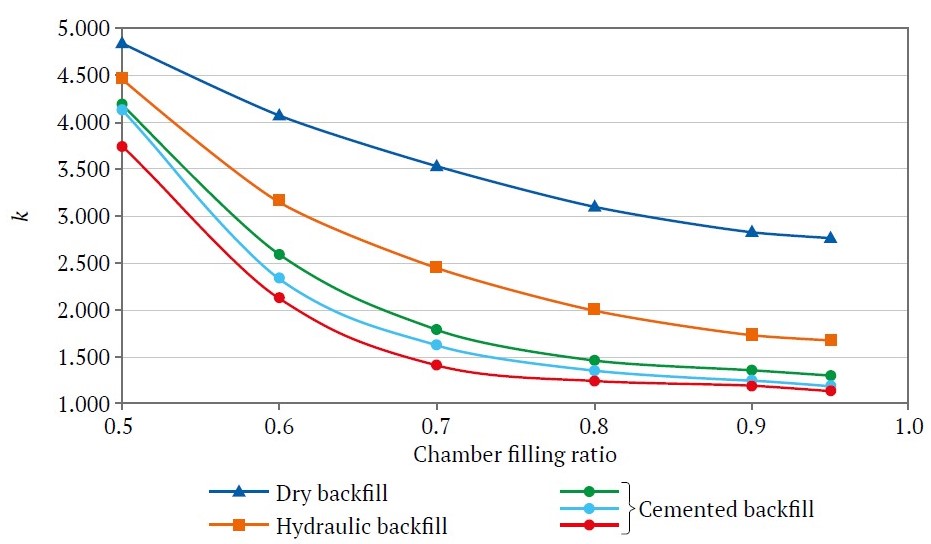
Fig. 4. Stress concentration coefficient as a function of backfill deformation properties and chamber filling ratio
The coefficient A can be expressed as a function of the seam extraction thickness m (m) with a coefficient of determination R2 = 0.9241:
A = X · e0.01m,
where X – is a coefficient depending on the type of backfill (0.8 for cemented backfill; 1.5 for hydraulic backfill; 2.9 for dry backfill).
The exponent B is described by a second-order polynomial function depending on the elastic modulus E (MPa) of the backfill mass; the coefficient of determination is R2 = 0.9458:
B = −0.000002 · E2 + 0.0033 · E + 0.5598.
When first-stage chambers are filled, a monolithic backfill structure is formed that prevents further stress accumulation in the barrier pillar and allows it to remain in a relatively unloaded state. The obtained relationships are valid for typical conditions of gently dipping potash seams occurring at depths of about 1100 m, with extraction thickness ranging from 5 to 20 m, provided that the required pillar loading conditions are maintained.
The stress level in the barrier pillar depends strongly on backfill characteristics. Dry backfilling of chambers has little effect on pillar stability [5, 28]. Hydraulic backfill provides some improvement but does not fully realize the potential of the proposed technology. Maximum recovery of second-stage chambers, with stresses in the barrier pillar reduced to the natural geostatic stress level, can only be achieved when cemented backfill is used.
The concept of limiting stress growth in the barrier pillar can be implemented when mining and backfilling operations are conducted simultaneously. The proposed method for mining deep potash seams is implemented as follows1.
The mining field is divided into extraction panels, separated by inter-panel barrier pillars. The width of the barrier pillars is calculated for conditions of complete undermining, in which the pillars are subjected to the load of the entire overburden column extending to the surface. Within each panel, mining is carried out using first-stage chambers, leaving rib pillars between them. These pillars are subjected to the load of the overlying rock mass within the natural arch of equilibrium.
As each first-stage chamber is completed, backfilling operations are initiated, so that mining and backfilling proceed simultaneously within the panel.
After adjacent panels have been backfilled, the inter-panel barrier pillar is mined using second-stage chambers. The number of second-stage chambers is determined by the width of the barrier pillar while accounting for the required width of the ICPs left between them. The width of these pillars is calculated based on the stress level acting in the barrier pillar after backfilling.
The proposed technology involves a pillar configuration in which the width of inter-chamber pillars decreases from the panel boundaries toward its central part (Fig. 5).

Fig. 5. Configuration of ICPs with variable width
The minimum width of ICPs is determined based on the degree of pillar loading, taking into account the time lag between mining and backfilling operations within the block, and is calculated using established empirical design relationships.
The width of the intermediate ICPs biICP increases linearly from the center toward the boundaries of the mining panel, while the average loading coefficient of ICPs within the panel Cavg must not exceed the maximum value permitted by regulatory guidelines:
Cavg = ∑(biICPСi)/∑biICP.
The presence of a zone with variable pillar width smooths the roof subsidence curve and reduces the stress level in the barrier pillar compared with the case where ICPs of uniform width are left within the mining panel. At the same time, the factor of safety of ICPs in the proposed configuration is not lower than in the baseline case and remains greater than 1 (Fig. 6), indicating that the proposed method does not reduce the level of operational safety.

Fig. 6. Factor of safety of ICPs
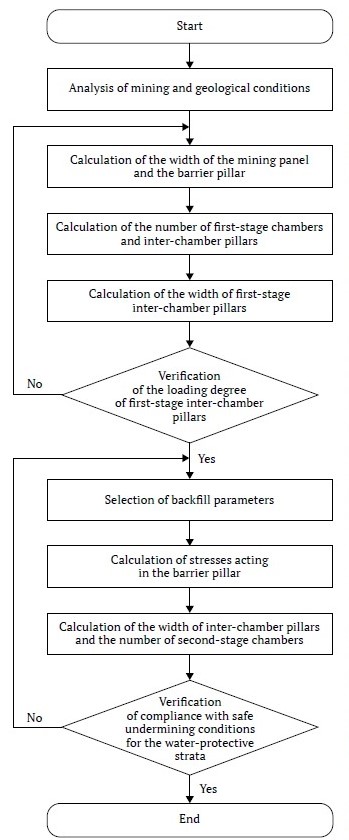
Fig. 7. Algorithm for determining the parameters of the proposed mining method for gently dipping potash seams at great depths
The backfill material is selected so that the calculated value of the empirical function k is minimized, which allows the stresses in the barrier pillar to be reduced as much as possible.
Based on the results of numerical modeling and current regulatory and technical standards governing potash mining operations, a methodology was developed for determining the parameters of the proposed technology for mining gently dipping potash seams at great depths with reduced ore losses. The algorithm of the proposed methodology is presented in Fig. 7.
1Kovalsky E. R., Kongar-Syuryun Ch. B., Sirenko Yu. G., Karpov G. N. Method for mining potash seams at great depths. Russian Federation patent application No. 2025136780; filed December 18, 2025.
A key issue in assessing the feasibility of the proposed technology is the need for backfilling operations, which has traditionally been regarded as a factor increasing both capital costs and the organizational complexity of mining operations [29]. Indeed, the construction and operation of a backfilling system require additional investment and are associated with a number of technological challenges [30, 31]. However, under modern deep potash mining conditions, backfilling of the mined-out space is no longer merely a desirable improvement but has become a practical necessity.
This conclusion is supported by the negative experience of several potash mines where the absence of backfilling operations in the past resulted in serious geomechanical and hydrogeological problems, including uncontrolled ground movements, brine inflows, and loss of excavation stability [32–34]. Preventing such phenomena at newly designed and operating mines requires the use of backfilling systems regardless of the selected mining method. In this context, the costs associated with the construction of a backfilling system, as well as the related organizational and technological challenges, should not be regarded as disadvantages of the proposed two-stage extraction method. Rather, they should be considered inevitable conditions for ensuring the safe and sustainable mining of deep potash seams.
An important advantage of the proposed technological solution lies in its compatibility with existing mine development and panel layout schemes. Implementation of two-stage extraction with backfilling does not require the development of a large number of additional access or development workings and does not imply a fundamental restructuring of the technological scheme adopted at the mine. This considerably reduces the barriers to practical implementation and allowing the proposed method to be implemented at operating mines with minimal changes to existing infrastructure.
Another important advantage of the proposed technology is the possibility of using large volumes of processing waste and waste rock in backfill mixtures. This approach makes it possible not only to address the problem of waste storage at the surface but also to reduce the negative environmental impact associated with mining operations. Consequently, the benefits of the proposed technology are multifaceted and consist of two main components. The first is a direct economic benefit resulting from the additional recovery of mineable reserves from barrier pillars. The second is an environmental and economic benefit associated with reducing the area occupied by waste storage facilities and preventing environmental contamination [35]. Taken together, these considerations indicate that the proposed technology, despite the objective challenges associated with the need for backfilling, represents not only a geomechanically justified but also a technologically feasible solution. Its implementation makes it possible to increase the completeness of reserve recovery while simultaneously addressing the tasks of industrial safety and environmental protection.
As a result of this study, a method for mining gently dipping potash seams at great depths has been developed and substantiated. The proposed method makes it possible to reduce operational losses through the secondary recovery of inter-panel barrier pillars. A key condition for implementing the proposed approach is the simultaneous execution of mining and backfilling operations, which limits stress growth in the barrier pillars and creates favorable conditions for their subsequent extraction using second-stage chambers.
For typical conditions of potash mining (depth 1100 m, seam extraction thickness 5 m), the results show that the use of cemented backfill reduces stress concentration in the barrier pillar to a level characterized by a coefficient k = 1.2. In contrast, when backfilling is not applied, this coefficient reaches k = 5.0. The resulting fourfold reduction in stresses makes it possible to carry out second-stage chamber mining within the boundaries of the barrier pillar, thereby enabling additional recovery of mineable reserves.
Based on the results of the study, the following main conclusions can be drawn:
Thus, the proposed method represents a geomechanically substantiated solution aimed at increasing the completeness of reserve recovery while ensuring safe mining operations. An additional benefit of the technology is the possibility of utilizing processing waste in backfill mixtures, which contributes to reducing the environmental impact of mining activities.
1. Kovalski E. R., Kongar-Syuryun Ch. B., Petrov D. N. Challenges and prospects for several-stage stoping in potash mining. Sustainable Development of Mountain Territories. 2023;15(2):349–364. (In Russ.) https://doi.org/10.21177/1998-4502-2023-15-2-349-364
2. Soloviev V. A., Sekuntsov A. I., Chernopazov D. S. Development and application of sylvinite seams excavation technology with pillar-and-chamber method in Verchnekamsk potash deposit. News of the Ural State Mining University. 2013;(4):41–46. (In Russ.) URL: https://iuggu.ru/index.php/archive/xxi-vek/2013/4-13/78-ru/195-4-13-07
3. Golovaty I. I., Petrovskij A. B., Prushak V. Y. Substantiation of the possibility of developing reserves of the Third potash horizon of the Starobin deposit, previously worked out by the chamber system. Proceedings of the National Academy of Sciences of Belarus. Physical-Technical Series. 2019;64(4):497–510. (In Russ.) https://doi.org/10.29235/1561-8358-2019-64-4-497-510
4. Toksarov V. N., Evseev A. V., Kuzmin V. S. Determination of mechanical properties of salt rocks in the mined-out part of the mine field at the BKPRU-2 mine. Nauchnye Issledovaniya i Innovatsii. 2011;5(2):154–156. (In Russ.)
5. Kovalskiy E. R., Kongar-Syuryun Ch. B., Sirenko Yu. G., Mironov N. A. Modeling of rheological deformation processes for room and pillar mining at the Verkhnekamsk potash salt deposit. Sustainable Development of Mountain Territories. 2024;16(3):1017–1030. (In Russ.) https://doi.org/10.21177/1998-4502-2024-16-3-1017-1030
6. Belyakov N. A., Belikov A. A. Prediction of the integrity of the water-protective stratum at the Verkhnekamskoye potash ore deposit. Mining Informational and Analytical Bulletin. 2022;(6–2):33–46. (In Russ.) https://doi.org/10.25018/0236_1493_2022_62_0_33
7. Toksarov V. N., Polyakov I. V., Beltyukov N. L. et al. Rock mass stress state at the Gremyachinskoe potassium deposit. Mining Informational and Analytical Bulletin. 2025;(1):100–113. (In Russ.) https://doi.org/10.25018/0236_1493_2025_1_0_100
8. Karasev M. A., Petrushin V. V., Rysin A. I. The hybrid finite/discrete element method in description of macrostructural behavior of salt rocks. Mining Informational and Analytical Bulletin. 2023;(4):48–66. (In Russ.) https://doi.org/10.25018/0236_1493_2023_4_0_48
9. Protosenya A. G., Belyakov N. A., Bouslova M. A. Modelling of the stress-strain state of block rock mass of ore deposits during development by caving mining systems. Journal of Mining Institute. 2023;262:619–627.
10. Ryl’nikova M. V., Berger R. V., Yakovlev I. V. et al. Backfill Technologies and designs for deep-level sylvinite mining. Journal of Mining Science. 2024;60(2):332-340. https://doi.org/10.1134/S1062739124020145 (Orig. ver.: Ryl’nikova M. V., Berger R. V., Yakovlev I. V. et al. Backfill Technologies and designs for deep-level sylvinite mining. Fiziko-Tekhnicheskie Problemy Razrabotki Poleznykh Iskopaemykh. 2024;(S2):167–176. (In Russ.) https://doi.org/10.15372/FTPRPI20240214)
11. Ilinov M. D., Korshunov V. A., Pospekhov G. B., Shokov A. N. Integrated experimental research of mechanical properties of rocks: Problems and solutions. Gornyi Zhurnal. 2023;(5):11–18. (In Russ.) https://doi.org/10.17580/gzh.2023.05.02
12. Gilev M. V., Konstantinova S. A., Marakov V. E., Chernopazov S. A. Stowing of goaf during sylvinite seams mining as a structural element of mining system. Mine Surveying Bulletin. 2007;(1):33–40. (In Russ.)
13. Tyulyaeva Y. S., Khayrutdinov A. M., Galachieva I. D., Totrukova I. K. Creation of a high-strength backfill composite based on sulfide-bearing technogenic waste from mining production. Sustainable Development of Mountain Territories. 2024;16(3):1384–1396. (In Russ.) https://doi.org/10.21177/1998-4502-2024-16-3-1384-1396
14. Agafonov V. V., Oganesyan A. S., Solovykh D. Ya., Kozlova O. Yu. Effect of polypropylene fiber on cement backfill based on tailings. Sustainable Development of Mountain Territories. 2023;15(4):1108–1118. (In Russ.) https://doi.org/10.21177/1998-4502-2023-15-4-1108-1118
15. Kozlovskiy E. Y., Zhuravkov M. A. Determination and verification of the calculated model parameters of salt rocks taking into account softening and plastic flow. Journal of Mining Institute. 2021;247:33–38. https://doi.org/10.31897/PMI.2021.1.4
16. Protosenya A. G., Katerov A. M. Substantiation of rheological model parameters for salt rock mass. Mining Informational and Analytical Bulletin. 2023;(3):16–28. https://doi.org/10.25018/0236_1493_2023_3_0_16
17. Karasev M. A., Petrushin V. V. Methodological issues in determination of initial parameters for modeling deformation of rock salt as a polycrystalline discrete medium. Mining Informational and Analytical Bulletin. 2024;9:47–64. https://doi.org/10.25018/0236_1493_2024_9_0_47
18. Kratzsch H. Bergschadenkunde. Berlin: Springer-Verlag; 1974. 582 p. (In German) (Trans. ver.: Kratzsch H. Rock mass displacement and protection of undermined structures. Transl. from German by R. A. Muller and I. A. Petukhov (Eds.). Moscow: Nedra; 1978. 494 p. (In Russ.))
19. Toksarov V. N., Morozov I. A., Beltyukov N. L., Udarcev A. A. Deformation of underground excavations under conditions of the Gremyachinsk potassium salt deposit. Mining Informational and Analytical Bulletin. 2020;(7):113–124. (In Russ.) https://doi.org/10.25018/0236-1493-2020-7-0-113-124
20. Qu H., Yin H., Li C., Wang W. Deformation characteristics and mechanism of salt structure: Research and discussion based on seismic analysis and tectonic simulation and implications for rock salt migration and mineralization in complex tectonic regions. Acta Geologica Sinica. 2024;98(10):2916–2930. (In Chinese) https://doi.org/10.19762/j.cnki.dizhixuebao.2024300
21. Asanov V. A., Pankov I. L. Study of deformation features of salt rocks under long-term loading. Mining Informational and Analytical Bulletin. 2010;(1):105–110. (In Russ.)
22. Sidki-Rius N., Bascompta M., Sanmiquel L., Yubero M. T. Definition of characteristic subsidence parameters. A case study in the Catalan potassium basin. Environmental Earth Sciences. 2024;83(19):566. https://doi.org/10.1007/s12665-024-11849-y
23. Konstantinova S. A., Aptukov V. N. Some problems of mechanics of deformation and fracture of salt rocks. Novosibirsk: Nauka; 2013. 191 p. (In Russ.)
24. Zhang Y., Lapatsin S., Zhuravkov M. et al. The stability and failure of deep underground structures at potash mining deposits. Applied Sciences. 2024;14(20):9434. https://doi.org/10.3390/app14209434
25. Stadnik D. A., Gabaraev O. Z., Stadnik N. M., Tedeev A. M. Improvement of methodical framework for autonomous scheduling of mining operations during underground mine design and planning. Mining Informational and Analytical Bulletin. 2020;(11–1):189–201. https://doi.org/10.25018/0236-1493-2020-111-0-189-201
26. Zubov V.P., Sokol D.G. Technologies of intensive development of potash seams by longwall faces at great depths: current problems, areas of improvement. Journal of Mining Institute. 2023;264:874–885.
27. Sirenko Yu. G., Kovalsky E. R. Improvement of selective potash extraction using shortwall mining with partial backfill. Gornyi Zhurnal. 2016;(1):24–26. (In Russ.) https://doi.org/10.17580/gzh.2016.01.05
28. Kovalsky E., Kongar-Syuryun C., Morgoeva A., Klyuev R., Khayrutdinov M. Backfill for advanced potash ore mining technologies. Technologies. 2025;13(2):60. https://doi.org/10.3390/technologies13020060
29. Khayrutdinov M. M., Aleksakhin A. V., Kibuk T. N. et al. Technogenic waste in backfill composite is a paradigm of circular economy. Mining. 2025;5(3):57. https://doi.org/10.3390/mining5030057
30. Kazanin O. I., Evsiukova A. A. Justification of the parameters of the paired workings development technology with the extracting of the pillar between workings by continuous miner. Mining Informational and Analytical Bulletin. 2025;(11–1):23–37. (In Russ.) https://doi.org/10.25018/0236_1493_2025_111_0_23
31. Jin R., Wang X., Zhang S. et al. Slurry transportation characteristics of potash mine cemented paste backfills via loop test processing. Processes. 2024;12(12):2929. https://doi.org/10.3390/pr12122929
32. Schleinig J.-P., Höntzsch S., Barnasch J. et al. A new technology to increase the extraction rate in potash mining areas – an approach for a safe secondary mining concept. In: Tomás R., Cano M., Riquelme A. et al. (Eds.) New Challenges in Rock Mechanics and Rock Engineering. 1st ed. Boca Raton, FL, USA: CRC Press; 2024. Pp. 772–777.
33. Baryakh A. A., Lomakin I. S., Samodelkina N. A., Tenison L. O. Loading of rib pillars in multiple seam mining at the upper Kama salt deposit. Mining Informational and Analytical Bulletin. 2023;(1):5–19. https://doi.org/10.25018/0236_1493_2023_1_0_5
34. Sidki-Rius N., Sanmiquel L., Bascompta M., Parcerisa D. Subsidence Management and Prediction System: a case study in potash mining. Minerals. 2022;12(9):1155. https://doi.org/10.3390/min12091155
35. Perevoshchikova A. A., Perevoshchikov R. D., Malyshkina E. E., Mitrakova N. V. Waste management in potash mining companies. Bulletin of the Tomsk Polytechnic University. Geo Assets Engineering. 2024;335(1):19–35. (In Russ.) https://doi.org/10.18799/24131830/2024/1/4387
Eugene R. Kovalsky – Cand. Sci. (Eng.), Associate Professor of the Department of Underground Mining
Saint Petersburg
Scopus ID 57189600737
ResearcherID E-2477-2014
SPIN 8295-5373
Cheynesh B. Kongar-Syuryun – PhD Student of the Department of Underground Mining
Saint Petersburg
Scopus ID 57212406315
SPIN 2461-3893
Kovalsky E.R., Kongar-Syuryun Ch.B. Recovery of barrier pillar reserves during deep potash seam mining. Mining Science and Technology (Russia). 2026;11(1):5-15. https://doi.org/10.17073/2500-0632-2026-02-1107




Editor-in-Chief
Petrov V.L. Email this article (Login required)
Email the author (Login required)
Email this article (Login required)
Email the author (Login required) 119049, Moscow, Leninsky Prospect, 4, b. 1
The National University of Science and Technology MISIS (NUST MISIS)
Tel.: +7 (968) 848-61-24
E-mail: send@misis.ru





