


Contents
Scroll to:
https://doi.org/10.17073/2500-0632-2025-12-1065
Scroll to:
Certain types of waste from mining and metallurgical industry have the potential to directly absorb carbon dioxide (CO2) from the atmosphere, as some of them contain minerals capable of carbonation. The paper demonstrates that belite sludges from the Achinsk Alumina Refinery (AAR, RUSAL Achinsk JSC), a byproduct of processing nepheline ores from the Kiya-Shaltyrskoye deposit, possess this property. An investigation of the variability in the mineral composition of the sludges as a function of storage duration in the sludge field (sludge storage facility), across the duration intervals of 0–5, 5–25, 25–50 years revealed a steady decrease in the content of calcium silicates (larnite, wollastonite, merwinite) and an increase in the content of carbonates as the sludge aged from fresh to old. This study examines the factors influencing the rate of sludge carbonation including those observed under conditions typical of an operational sludge storage facility. The electron microscopy (SEM-EDS) analysis of the sludge revealed the porous structure of the silicate particles in the sludge, as well as the extent to which they had been replaced by calcite. An assessment has been conducted of this storage facility’s potential for carbon dioxide deposition through the carbonation of silicate minerals in sludge that are chemically unstable under atmospheric conditions. Based on the results of the analysis and literature data on the CO2 absorption capacity of calcium silicates under atmospheric conditions, it was concluded that larnite has the maximum absorption potential in belite sludges. Based on the conditions at the ARR’s belite sludge storage facility, the maximum volume of CO2 that can be absorbed during complete interaction between larnite and atmospheric air has been calculated. The absorption capacity of one ton of the sludge solely due to larnite (with its content of 32.6%) is 83.3 kg of CO2, and taking into account wollastonite and merwinite, the total potential reaches 262 kg/t. The scale and dynamics of the process of converting silicates into carbonates in the sludge storage facility will allow the volume of absorbed carbon dioxide to be taken into account in calculations of the carbon footprint of the enterprise’s end-use product, aluminum produced from nepheline ore.
Makarov V.A., Koulemou L.T., Mikheev V.G., Lobastov B.M. Potential for using belite sludge from the Achinsk Alumina Refinery to reduce the carbon footprint of aluminum production. Mining Science and Technology (Russia). 2026;11(1):46-55. https://doi.org/10.17073/2500-0632-2025-12-1065
Reducing the carbon footprint of large industrial enterprises is becoming a key factor in their competitiveness. In October 2021, the Russian government approved a strategy for Russia’s low-carbon socioeconomic development through 2050, which calls for reducing emissions to 70% of the 1990 levels by 2030.
According to experts, CCUS (Carbon Capture, Utilization, and Storage) technologies which encompass a range of methods for capturing, utilizing, and storing carbon dioxide (CO2) will play a key role in reducing greenhouse gas emissions and addressing climate change [1–3]. The main components of CCUS are: Capture – separating CO2 from industrial emissions (e.g., thermal power plants, cement plants) or directly from the air; Utilization – using CO2 in industry; Storage – geological disposal (pumping CO2 into underground geological formations (former oil and gas fields, saline aquifers)) or mineralization (binding CO2 into solid carbonates). The latter area is related to the development of technologies for Direct Air Capture (DAC) of CO2.
Wastes from mining and metallurgical industry have the potential to directly absorb CO2 from the atmosphere, as many of these materials (tailings, overburden, slag, sludge, etc.) may contain minerals capable of carbonation. In particular, some mining waste (especially ultrabasic and basic rocks) contains calcium, magnesium, and iron silicates (olivine, serpentine, wollastonite, etc.), which are chemically unstable under surface conditions and, when interacting with atmospheric gases, are capable of binding CO2 into stable carbonates (calcite, magnesite, etc.) [4–6].
The purpose of this study is to demonstrate the potential and feasibility of using belite sludge, a byproduct of the Achinsk Alumina Refinery, to absorb carbon dioxide from the atmosphere.
The objectives of the study included examining the variability of the mineral composition of the sludge as a function of its storage duration in the sludge storage facility and assessing the potential of this storage facility for carbon dioxide deposition through the carbonation of the sludge silicate minerals, which are chemically unstable under atmospheric conditions.
The Achinsk Alumina Refinery (ARR, RUSAL Achinsk JSC) was commissioned in 1973. Alumina is produced at the refinery by processing nepheline ore from the Kiy-Shaltyrskoye deposit. An important environmental aspect of the alumina production at this facility is the generation of large amounts of waste, belite sludge, which is stored in a sludge storage facility located in the floodplain of the Chulym River (Fig. 1).

Fig. 1. Location of the ARR’s sludge storage facility and its general view with indicating sludge depositing sites of different ages: fresh sludge (0–5 years of storage); intermediate age sludge (5–25 years of storage); old sludge (25–50 years of storage)
The sludge storage facility covers an area of 90 hectares, and the sludge pile is over 100 m high. The total volume of the belite sludge accumulated exceeds 300 million tons.
Research into the properties of the sludge and its potential applications in the national economy began almost as soon as the refinery began operations. Since then, various applications have been identified: production of belite cement and soda ash products, use as soil ameliorant (soil deoxidizer), sorbent, and food additive in poultry feed; pigment for paint production, and others.
Despite the wide range of the belite sludge application properties, the volume of its reuse is insignificant (no more than 20% of the amount delivered to the depositing sites) and is incomparable with the scale and speed of accumulation. At the same time, given the significant volume of this material, it seems appropriate to consider it as a promising candidate for carbon capture, since the magnesium and calcium silicates contained in these sludge dumps are potential materials for binding atmospheric CO2 into stable carbonates. This technological approach is relevant to combating the greenhouse effect and could be one of the factors in reducing the carbon footprint of the alumina produced at the refinery and, ultimately, of the aluminum produced.
The basis for this study was a quantitative X-ray phase analysis of three randomly selected sludge samples from depositing sites with different storage durations, which revealed a sharp decline in the calcium silicate content in the sludges following prolonged exposure to the atmosphere (Fig. 2). Sludges (samples) collected from different depositing sites were conditionally classified as "old," "intermediate," and "fresh".
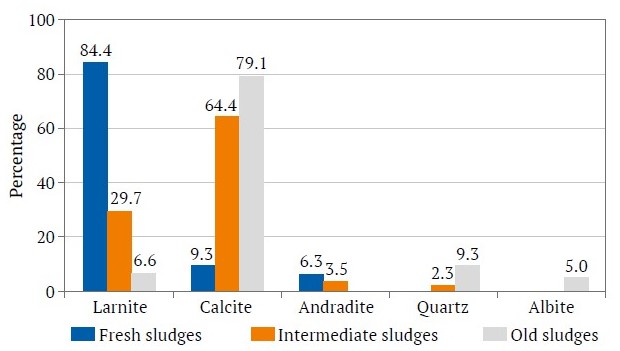
Fig. 2. Trends of variability in the content of larnite and calcite in sludges of different storage duration (randomly selected samples from the surface of the depositing sites): fresh sludge (0–5 years of storage); intermediate sludge (5–25 years of storage); old sludge (25–50 years of storage)
The methodology for further research included the selection of 76 samples of sludge of various ages from the surface of the depositing sites, as well as a comparative study of their mineral (X-ray phase analysis, optical and electron microscopy) and chemical (ICP-AES, ICP-MS) composition.
Lithologically, the sludge is a loose material with a predominance of sand and silt particles, i.e., the sludge corresponds to silty sand. At depths up to 2.5–4 m, the sludge is generally loose, while at greater depths it becomes cemented due to the interaction of the sludge water with calcium silicates (larnite, wollastonite, and merwinite). In some cases, cementation of the sludge starting from the surface is observed. With increasing depth, the content of coarse-grained sludge (up to the size of coarse sand) increases, while the content of silt (dust-like) fractions decreases.
The sludge storage facility is formed by hydraulicking using a system of sludge pipelines with a recirculating water system. This determines the layered texture of sludge characteristic of sedimentary rocks. The layers dip at angles of 1–5° toward the center of the storage facility. The composition of the sludge and its structural and textural characteristics account for its high porosity and good surface water drainage. Process water supplied to a depositing site via the sludge pipelines has a temperature of about 60 °C, which, together with high humidity and good aeration of the sludge material, leads to the intensive formation of secondary minerals, including in cold season (Fig. 3).

Fig. 3. The formation of a white crust composed of secondary minerals (potassium and sodium salts + carbonates) in the sludge (left).
Samples (15-cm-long sample channels) were collected from the sludge near the sludge discharge point from a layer formed two months ago.
Graphs showing the distribution of calcite and carbon in samples based on X-ray phase and X-ray fluorescence analyses, respectively are shown on the right.
It is noteworthy that the highest contents of calcite, as well as carbon, were found within the interval of 15–30 cm from the surface, which is likely due to specific humidity conditions and the absorption of carbon dioxide from the air.
The chemical composition of the sludge and the features of its variability over time are presented in Table 1.
Table 1
Chemical composition of belite sludge based on ICP-AES data*
(average contents for 10-sample sets)
Elements, g/t | Sludge category by storage duration**) | ||
Fresh (FR) | Intermediate (IN) | Old (OL) | |
As | 10.6 | 9.3 | 11.2 |
B | 22.0 | 22.8 | 20.8 |
Ba | 290.8 | 298.2 | 208.6 |
Ca | 297294.0 | 285448.4 | 296804.6 |
Co | 8.2 | 7.6 | 7.3 |
Cr | 29.3 | 22.5 | 25.5 |
Cu | 16.9 | 30.0 | 20.5 |
Li | 12.2 | 10.1 | 11.8 |
Mg | 10724.1 | 9314.8 | 7530.5 |
Na | 11587.7 | 7140.7 | 5346.8 |
Ni | 16.6 | 15.1 | 14.8 |
P | 1242.6 | 1119.9 | 1197.7 |
Pb | 16.4 | 22.7 | 17.2 |
S | 1338.3 | 787.3 | 889.4 |
Sb | 2.9 | 2.4 | 3.1 |
Sn | 1.3 | 1.2 | 1.2 |
Sr | 986.4 | 982.9 | 907.7 |
Ti | 2032.4 | 1833.0 | 1790.5 |
Zn | 46.4 | 48.3 | 52.4 |
* The assays were performed at the laboratory of TsGI Prognoz LLC.
** FR – 0–5 years; IN – 5–25 years; OL – 25–50 years.
The table shows that, for most elements, there are no significant changes in the composition of the sludge samples with changing storage duration. The active removal of elements from the surface of sludge dumps is observed for magnesium and sodium only.
X-ray phase analyses of the sludge samples (two samples were analyzed from each depositing site) selected at random from the surface) showed that, in addition to larnite, the samples contained wollastonite and merwinite among the calcium silicates (Table 2).
Table 2
Mineralogical composition of belite sludge samples of different storage duration*,
according to quantitative X-ray phase analysis data, %**
Material/Mineral | Larnite | Wollastonite | Merwinite | Calcite | Vaterite | Aragonite |
Fresh sludge (FR1) | 20.8 | 49.3 | 2.22 | 20.9 | 2.8 | 3.44 |
Fresh sludge (FR2) | 44.4 | 34.8 | 7.36 | 7.94 | 2.18 | 1.15 |
Intermediate sludge (IN1) | 3.8 | 57.0 | 12.0 | 31.5 | 2.82 | 3.05 |
Intermediate sludge (IN2) | 16.5 | 62.5 | 3.13 | 12.2 | 2.35 | 2.91 |
Old sludge (OL1) | 9.54 | 58.4 | 1.7 | 18.8 | 5.1 | 1.89 |
Old sludge (OL2) | 8.97 | 58.4 | 0.85 | 23.50 | 3.28 | 1.58 |
* FR – 0–5 years; IN – 5–25 years; OL – 25–50 years.
** Analyses performed at the Multiple-access Center of the Institute of Non-Ferrous Metals, Siberian Federal University.
Table 3 shows that the sum of calcium and magnesium silicates in the fresh sludge–intermediate sludge–old sludge series decreases sequentially: 79.44–76.96–68.9 (%), while the total carbonate content increases: 18.98–27.47–27.09 (%). At the same time, the high carbonate content found in one of the fresh sludge samples (Table 2, sample FR1) reflects the rapid and uneven carbonation of the silicate minerals contained therein. An example of such a high carbonation rate under favorable conditions is shown in Fig. 3.
Table 3
Average mineral contents in sludges of different storage duration
Material/Mineral | Larnite | Wollastonite | Merwinite | Calcite | Vaterite | Aragonite |
Fresh sludge (FR) | 32.6 | 42.05 | 4.79 | 14.2 | 2.49 | 2.29 |
Intermediate sludge (IN) | 10.15 | 59.25 | 7.56 | 21.85 | 2.64 | 2.98 |
Old sludge (OL) | 9.25 | 58,4 | 1.25 | 21.15 | 4,19 | 1.75 |
To assess the features of the processes involved in the replacement of calcium silicates by carbonate, electron microscopic studies were conducted on three samples of sludges of different ages. Fresh, intermediate, and old sludge samples were studied using the SEM-EDS method. Polished microsections were prepared from the epoxy-cemented sample material for the microscopic examination.
SEM-EDS analyses were performed at the Norilsk Nickel–SFU R&D Center using a Tescan Vega III SBH system with an integrated Oxford X-Act system, operating at an accelerating voltage of 20 kV and a probe current of 2.0 nA (on a Faraday cup); spectra were accumulated from point to scale of 300,000 pulses. In the investigation, standard samples of chemically pure elements and compounds of MAC standards (Micro-Analysis Consultants Ltd, United Kingdom; reg. No. 11192) were used: O – SiO2, Al – Al2O3, Si – SiO2, Ca – wollastonite, CaSiO3. Oxygen was determined both directly and by stoichiometry that allowed indirect assessment of the presence of hydroxyl groups and/or water in minerals. The probe current was measured using a MAC cobalt metal standard (reg. No. 9941) every 60 minutes during the study.
The samples were carbon-coated using the Quorum 150 RES automated conductive coating system with thickness control; the coating thickness was 20 nm.

Fig. 4. "Fresh" sludge; globular aggregates of calcium silicates are clearly visible: light gray larnite (Lrn) and wollastonite (Wo) with a few bright spots representing iron particles. Photo in back scattered electrons
The results of the studies showed that the “fresh” sludge consists mainly of calcium silicates (Fig. 4). Its particle size ranges from the first tens of micrometers to 0.5 mm. The particles shape is irregular, blob-like, or amoeboid; angular, polygonal particles are also observed. Upon closer examination, the following was observed:
The particles contain a very small amount of calcium carbonate; besides, rounded and irregularly shaped iron particles were occasionally observed (bright spots in Fig. 4).
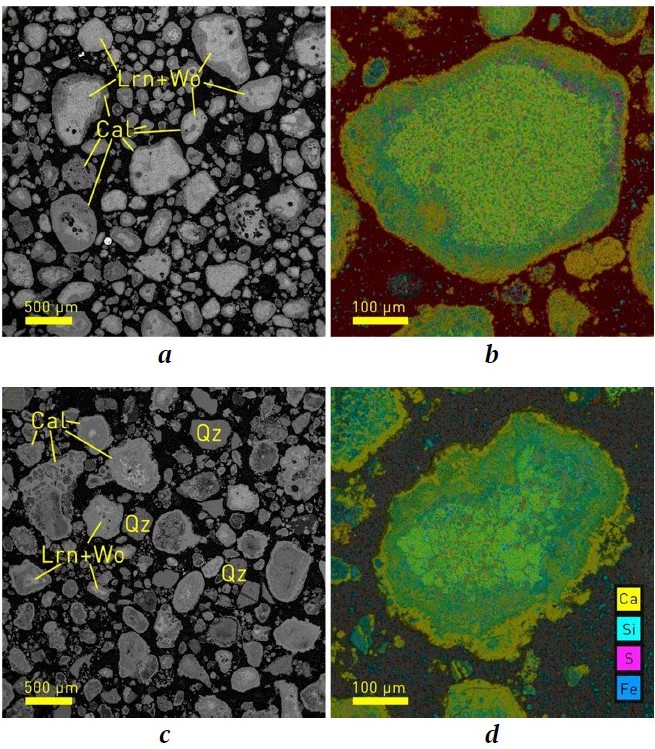
Fig. 5. "Intermediate" (a, b) and "old" (c, d) sludges; zonal structure of the particles is clearly visible:
in the central part, light gray material occurs, presented by calcium silicates larnite Lrn and wollastonite Wo;
dark gray calcite Cal develops at the periphery, and a few quartz Qz particles are identified;
images b and d present multi-element maps in pseudo-colors, with symbols shown in the image. Photo in back scattered electrons
In the "intermediate" and "old" sludges, calcium silicate replacement with carbonate was observed. Fig. 5 shows the particle general distribution and features of alteration in particles in "intermediate" and "old" sludges. It is clearly visible that the bright areas in the particle nuclei are very small. This is more common in "intermediate" sludges, where they may be absent at all. Complete replacement of silicates is more commonly observed in "old" sludge, indicating a significantly greater degree of alteration of the initial material. Figure 5 also shows multi-element maps of individual particles that have undergone varying degrees of alteration: their cores consist of small calcium silicate globules, while a compact crust of calcium carbonate forms along the periphery, appearing darker in backscattered electrons compared to the core.
Findings Discussion
The data obtained on the mineral composition of the ARR’s belite sludges and the trends in its variability indicate that silicate carbonation processes are occurring in the storage facility under current conditions. Under atmospheric conditions, all silicates (larnite, wollastonite, merwinite), which compose the bulk of the sludge, are capable of absorbing CO2 to varying degrees.
The stability of these silicates in atmospheric conditions and the rate of carbon dioxide absorption vary and depend on a number of factors, namely: environmental factors, factors related to the nature of the material, and products formed as a result of the reaction [7, 8].
Within the first group of factors, the governing factor is the concentration of CO2 in the atmosphere (the higher the concentration of carbon dioxide in the air, the faster the reaction). Humidity is also a critically important factor. If the humidity is too low (<~25%), there is not enough water for the hydration reaction and the carbonation process itself to take place (CO2 must dissolve in water). When humidity is too high (> ~90%), the pores in the material become saturated with water, which slows down gas diffusion. Humidity levels between 50% and 70% are considered optimal [9, 10]. Temperature has a twofold effect on the rate of carbonation.
As the temperature rises, the rate of chemical reaction increases (Van't Hoff's rule). However, elevated temperatures can also reduce relative humidity and CO2 solubility that in these reactions can lead to the opposite result. The progress in the secondary mineral formation on the surface of the storage facility shown in Fig. 3 indicate a high rate of secondary carbonate formation and the appearance of abnormal carbon contents under a thin surface layer. This is obviously due to the dissolution of carbon dioxide from the air in pore water, where evaporation is minimal and the temperature conditions are optimal for the replacement of calcium silicates.
In general, within moderate ranges, rising temperatures accelerate carbonation. When considering environmental factors in relation to the storage conditions of the ARR’s belite sludges, it can be noted that these factors combine in a way that is conducive to carbonation. This relatively high CO2 content is due to the storage facility being located in an industrial area of the city, with increased humidity caused by both precipitation (movable elements are being carried away, see Table 1) and the evaporation of process water at discharge points at the depositing sites, whose temperatures can range from 60 to 80 °C. Hot process water also serves as a favorable temperature factor for carbonation in winter. At the water discharge point, there is a local thermal anomaly that exists year-round.
The key material-related factors are mineralogical composition, as well as porosity and permeability. The latest two factors determine the access of CO2 into the material. The more open pores and capillaries there are, the easier it is for CO2 to penetrate deeply and the higher the carbonation rate. For the ARR’s belite sludges, the fine-grained and sandy particle coarseness of the calcium silicates, as well as the high porosity of each individual sludge particle (see Fig. 4), are highly favorable factors. This suggests that the belite sludge storage facility is permeable to atmospheric carbon dioxide, at least in its upper part.
The mineralogical composition of sludge has a significant effect on the rate of carbonation. The predominant silicates in the composition of the ARR’s sludges, which determine their carbonation rate, are larnite and wollastonite. The reactions and conditions for carbon dioxide absorption by these minerals are different. For larnite, carbonation occurs in stages through its hydration, resulting in the formation of portlandite and a calcium hydrosilicate (Ca₂SiO₄ + 3H₂O → Ca(OH)₂ + CaO·SiO₂·aH₂O), followed by carbonation of portlandite (Ca(OH)₂ + CO2 → CaCO3 + H2O) and then carbonation of the calcium hydrosilicate (CaO·SiO2·aH2O + CO2 → CaCO3 + SiO2·bH2O + H2O) [11–13].
The literature indicates that the rate of carbonation of larnite under atmospheric conditions is quite high. However, it is a variable quantity and depends on the formation of a passivating carbonate film on the surface. At the initial stage, the reaction proceeds relatively quickly on the newly formed surface, since the concentration of CO2 and the availability of calcium ions are at their highest. As a layer of calcium carbonate (CaCO₃) forms on the surface of the larnite particles, this layer begins to act as a barrier. For the reaction to continue, the CO2 molecules and water must diffuse through this layer, while the calcium ions and silicic acid must diffuse out of it. This diffusion process significantly slows down the overall reaction rate [7, 11]. The phenomena described are clearly observed in belite sludges of different storage durations at the ARR. Fig. 5 shows that large calcium silicate particles are surrounded by a rim of calcium carbonate, while small particles are often completely replaced by carbonate.
The international literature includes studies assessing the dynamics and extent of carbon dioxide uptake by larnite under atmospheric conditions [14, 15]. The observations and experiments described there, conducted on steelmaking waste (slag) – the main mineral of which is larnite (50% of the initial slag) – showed that CO2 absorption at room temperature amounts to 243 kg per ton of fresh steelmaking slag.
The carbonation rate of wollastonite under atmospheric conditions (0.04% CO2, 25 °C) is quite low and almost imperceptible. However, under optimized conditions (high CO2 concentrations, elevated temperature, fine grinding, presence of water), the reaction can proceed quite rapidly. The main difference from larnite is that wollastonite does not require a hydration stage and is carbonatized directly [16,17].
A study by Canadian researchers assessed the weather resistance of wollastonite and its ability to absorb CO2 through carbonation under atmospheric conditions. A comparative analysis of CO2 absorption rates by kimberlite beneficiation tailings from mines in northwestern Canada and wollastonite ore rich in CaSiO3 mined at a deposit in Ontario showed that wollastonite ore is more prone to weathering and carbonation than the kimberlite tailings (which contain slowly weathering hydrated magnesium silicates and aluminosilicates). However, under atmospheric conditions, the process is slow [8, 18, 19].
Table 4
Carbon dioxide absorption capacity of one ton of ARR’s belite sludge
Masses (of mineral and absorbed CO2) from 1 ton of sludge | Fresh sludge (FR) | |
Test charge, kg | ||
Larnite, CO2, kg | Larnite Ca₂SiO₄ | 326.00 |
CO2 | 83.30 | |
Wollastonite, CO2, kg | Vollastonite CaSiO₃ | 420.50 |
CO2 | 159.31 | |
Merwinite, CO2, kg | Mervinite Ca₃Mg[SiO₄]₂ | 47.90 |
CO2 | 19.24 | |
Total, kg | CO2 | 261.85 |
Minerals | 794.40 | |
Based on the analysis conducted and the literature data on the CO2 absorption capacity of calcium silicates under atmospheric conditions [12, 14, 20], it can be concluded that larnite possesses the highest absorption potential. With regard to the conditions of the ARR’s belite sludge storage, it is possible to calculate the maximum volume of the absorbed gas assuming the minerals react completely with atmospheric air (Table 4).
Key Findings
1. Ryabov G. A., Petelin S. A., Vivchar A. N. et al. Technologies for capturing carbon dioxide at thermal power plants, its transportation, useful use and storage. In: Klimenko A. V. (Ed.) Ecology, Energy, Energy Saving. Iss. 3. Moscow: PJSC Mosenergo; 2022. 32 p. (In Russ.)
2. Osiptsov A. A., Gayda I. V., Grushevenko E. A., Kapitonov S. A. Carbon capture, utilization and storage (CCUS) technologies – the technological basis for decarbonizing heavy industry in the Russian Federation. Moscow: Project Center for Energy Transition and ESG; 2022. 79 p. (In Russ.)
3. Zevenhoven R., Back J., Fagerlund J., Sorjonen-Ward P. Mineral carbonation using mine tailings – A strategic overview of potential and opportunities. Cheltenham, UK: IEA Greenhouse Gas R&D Programme (IEAGHG); 2022 Jul. 123 p. Report No.: 2022-10.
4. Sanna A., Uibu M., Caramanna G. et al. A review of mineral carbonation technologies to sequester CO2. Chemical Society Reviews. 2014;43(23):8049–8080. https://doi.org/10.1039/c4cs00035h
5. Kusin F. M., Hasan S. N. M. S., Molahid V. L. M. et al. Carbon dioxide sequestration of iron ore mining waste under low-reaction condition of a direct mineral carbonation process. Environmental Science and Pollution Research. 2023;30(9):22188–22210. https://doi.org/10.1007/s11356-022-23677-3
6. Ibrahim M. H., El-Naas M. H., Benamor A. et al. Carbon mineralization by reaction with steel-making waste: a review. Processes. 2019;7(2):115. https://doi.org/10.3390/pr7020115
7. Santos A., Ajbaryb M., Morales-Florezb V. et al. Larnite powders and larnite/silica aerogel composites as effective agents for CO2 sequestration by carbonation. Journal of Hazardous Materials. 2009;168(2–3):1397–1403. https://doi.org/10.1016/j.jhazmat.2009.03.026
8. Chai Y. E., Chalouati S., Fantucci H., Santos R. M. Accelerated weathering and carbonation (mild to intensified) of natural Canadian silicates (kimberlite and wollastonite) for CO2 sequestration. Crystals. 2021;11(12):1584. https://doi.org/10.3390/cryst11121584
9. Allah P., Nguyen H., Illikainen M. et al. Wet carbonation of wollastonite with pH-modified solutions at ambient conditions: Insights from a geochemical model. Journal of CO2 Utilization. 2025;101:103194. https://doi.org/10.1016/j.jcou.2025.103194
10. Gineika A., Siauciunas R., Baltakys K. Synthesis of wollastonite from AlF3-rich silica gel and its hardening in the CO2 atmosphere. Scientific Reports. 2019;9(1):18063. https://doi.org/10.1038/s41598-019-54219-6
11. Huijgen W. J. J., Comans R. N. J. Carbon dioxide sequestration by mineral carbonation: literature review. Petten: Energy Research Centre of the Netherlands (ECN); 2003 Feb. Report No.: ECN-C--03-016. 52 p.
12. Johnson D. C., MacLeod C. L., Carey P. J., Hills C. D. Solidification of stainless-steel slag by accelerated carbonation. Environmental Technology. 2003;24(6):671–678. https://doi.org/10.1080/09593330309385602
13. Montes-Hernandez G., Renard F. Time-resolved in situ Raman spectroscopy of the nucleation and growth of siderite, magnesite, and calcite and their precursors. Crystal Growth & Design. 2016;16(12):7218–7230. https://doi.org/10.1021/acs.cgd.6b01406
14. Crouzet C., Brunet F., Montes-Hernandez G. et al. Hydrothermal valorization of steel slags – Part I: coupled H2 production and CO2 mineral sequestration. Frontiers in Energy Research. 2017;5:29. https://doi.org/10.3389/fenrg.2017.00029
15. Fritz B., Clement A., Montes-Hernandez G., Noguera C. Calcite formation by hydrothermal carbonation of portlandite: complementary insights from experiment and simulation. CrystEngComm. 2013;15(17):3392–3401. https://doi.org/10.1039/c3ce26969h
16. Wang T., Tang W., Zhang W. et al. Effect of surface water on wollastonite carbonation: activated dissolution and mass transfer. Chemical Engineering Journal. 2024;485:149324. https://doi.org/10.1016/j.cej.2024.149324
17. Coppola A., Scala F., Azadi M. Direct dry carbonation of mining and industrial wastes in a fluidized bed for offsetting carbon emissions. Processes. 2022;10(3):582. https://doi.org/10.3390/pr10030582
18. Sipilä J., Teir S., Zevenhoven R. Carbon dioxide sequestration by mineral carbonation: literature review update 2005–2007. Turku: Åbo Akademi University, Heat Engineering Laboratory; 2008. Report No.: VT 2008-1. 59 p. URL: https://www.remineralize.org/wp-content/uploads/2015/10/LITR1.pdf
19. Saran R. K., Arora V., Yadav S. CO2 sequestration by mineral carbonation: a review. Global NEST Journal. 2018;20(3):497–503. https://doi.org/10.30955/gnj.002597
20. Bourgeois F., Julcour C. Rapport bibliographique. Programme «Carboscories». Nouméa: CNRT «Nickel & son Environnement»; 2015. 43 p. (In French)
Vladimir A. Makarov – Dr. Sci. (Geol.-Mineral.), Professor, Head of the Department of Geology of Mineral Deposits and Exploration Methods, Institute of Non-Ferrous Metals and Materials Science,
Krasnoyarsk
Scopus ID 57188966055
SPIN 8941-0236
Laurent Thiebo Koulemou – PhD Student, Department of Geology of Mineral Deposits and Exploration Methods, Institute of Non-Ferrous Metals and Materials Science
Krasnoyarsk
Vladimir G. Mikheev – Cand. Sci. (Geol.-Mineral.), Professor, Department of Geology of Mineral Deposits and Exploration Methods, Institute of Non-Ferrous Metals and Materials Science,
Krasnoyarsk
SPIN 2100-3262
Boris M. Lobastov – Senior Lecturer, Department of Geology, Mineralogy and Petrography, Institute of Non-Ferrous Metals and Materials Science
Krasnoyarsk
Scopus ID 57211486240
SPIN 4368-7330
Makarov V.A., Koulemou L.T., Mikheev V.G., Lobastov B.M. Potential for using belite sludge from the Achinsk Alumina Refinery to reduce the carbon footprint of aluminum production. Mining Science and Technology (Russia). 2026;11(1):46-55. https://doi.org/10.17073/2500-0632-2025-12-1065




Editor-in-Chief
Petrov V.L. Email this article (Login required)
Email the author (Login required)
Email this article (Login required)
Email the author (Login required) 119049, Moscow, Leninsky Prospect, 4, b. 1
The National University of Science and Technology MISIS (NUST MISIS)
Tel.: +7 (968) 848-61-24
E-mail: send@misis.ru





